
Nadella Personally Takes Control of Copilot, Slams "Not Smart" Integrations
CEO intervenes after criticizing Copilot's "not smart" failures to integrate email, driving a crucial internal reckoning.
December 28, 2025
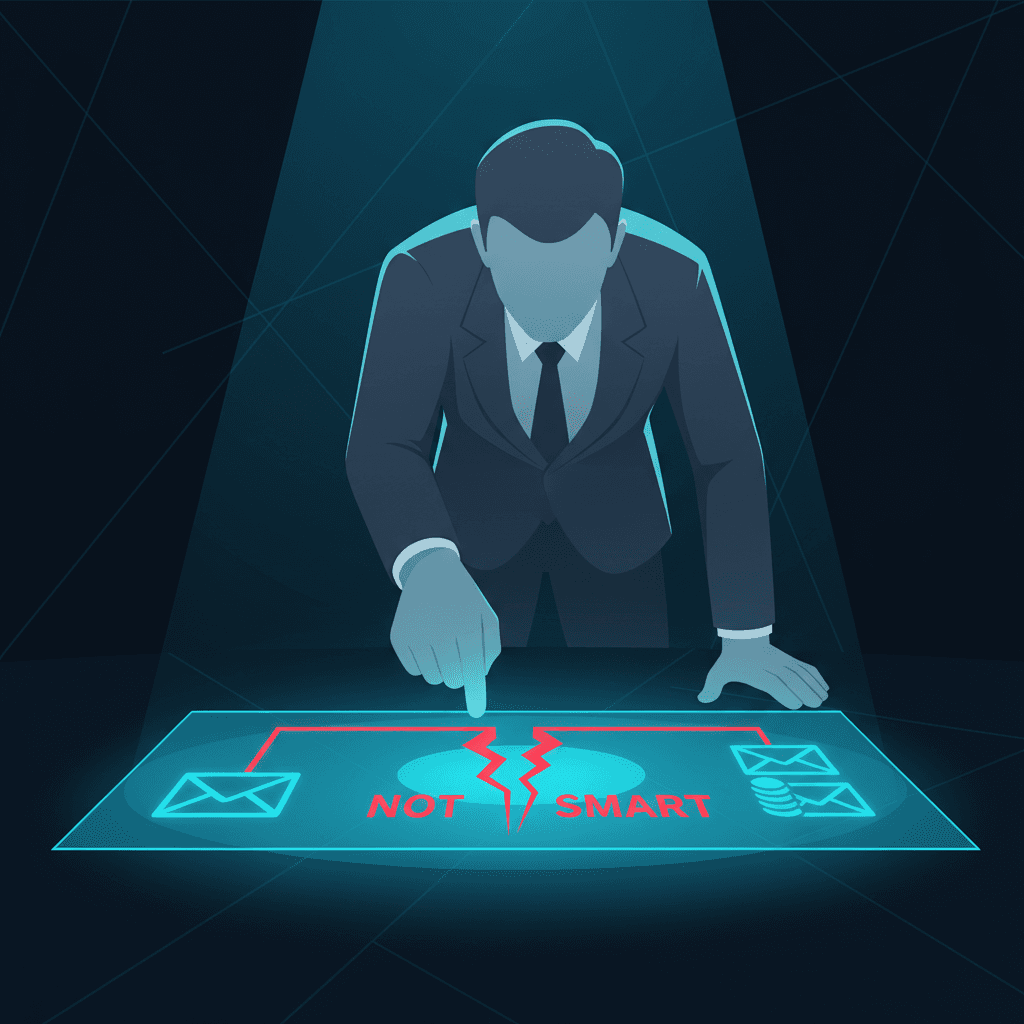
An extraordinary intervention by Microsoft CEO Satya Nadella has brought the intense pressure of the enterprise AI race into sharp focus, with reports indicating he has personally stepped into the product development of the company’s flagship Copilot assistant. The CEO, known for his strategic vision, is said to have criticized Copilot's fundamental functional capability, specifically its integrations with major email platforms, telling managers that the tools connecting it to Gmail and Outlook "for the most part don't really work" and are "not smart."[1][2][3] This candid internal critique signals an urgent reckoning within the company as it confronts the reality that its market-leading position in AI software is being challenged by rivals like Google's Gemini, which are moving quickly to provide deeper, more context-aware integrations.[1][2][3][4]
Nadella's blunt assessment reportedly came in an internal email to engineering leaders working on the consumer version of Copilot, following a manager's observation that Google's Gemini chatbot had advanced its connection with Google Drive, allowing it to perform tasks such as summarizing the contents of photo folders.[2][3][5] This comparison served as a clear competitive benchmark, highlighting a perceived feature and quality gap that has now spurred the CEO to adopt an unusually hands-on, operational role in product management.[2][3] Over the past several months, Nadella has effectively morphed into Microsoft's most influential product manager, a shift in focus he signaled by delegating some of his commercial responsibilities to concentrate more heavily on AI development.[3][6] This deeper involvement includes active participation in a private Microsoft Teams channel with roughly 100 of the company's top technical staff, where he posts detailed critiques when he believes AI products are falling short.[2][3][6] Furthermore, he holds a weekly hour-long meeting with many of the same engineers, grilling them on their progress and issuing specific technical directives, such as consolidating how different teams handle the post-training phase of AI model development to streamline processes.[1][2][3][5][6]
The core challenge identified by Nadella is the failure of Copilot to deliver on the promise of a seamless, truly unified AI layer that works across a user’s disparate digital life. The current integrations, designed to let Copilot access and act upon personal data within services like Gmail and Outlook, are meant to enable high-value tasks such as drafting complex replies, summarizing long email threads across multiple services, or finding specific information without requiring a user to manually switch between applications.[7][4][8] When the connections "don't really work," the promised efficiency gains are negated, forcing users to manually verify information or revert to traditional methods, which undercuts the value proposition of a premium AI assistant.[7] Technical difficulties in achieving this cross-platform functionality are significant, involving complex issues of permissions, authorization via OAuth protocols for external services, granular identity management for enterprise customers, and the fundamental engineering challenge of data grounding—ensuring the AI can reliably verify its outputs against the source content to prevent hallucinations.[4] If the AI cannot consistently and intelligently draw context from a user’s primary communication channels, whether they are in Microsoft's own ecosystem or a competitor's like Google's, the product risks being perceived as a costly novelty rather than an indispensable tool.[7][9][10]
Microsoft's intensified focus and the CEO's direct intervention highlight the fierce competition in the rapidly evolving market for generative AI assistants. While Copilot, leveraging Microsoft's investment in OpenAI, was an early frontrunner, the landscape is shifting quickly. The pressure comes not only from direct rivals like Google's Gemini, which is showing deeper integration in its own ecosystem, but also from free tools like OpenAI's ChatGPT, which some enterprise customers are using as a benchmark for what AI should deliver.[9] Reports indicate that some early Copilot enterprise adopters are questioning its real-world value proposition and considering not renewing subscriptions, signaling that the high cost of the service must be justified by an "incredible" return on investment.[9] This "code red" scenario has prompted Microsoft to not only accelerate product iteration but also to aggressively recruit top-tier talent from competing labs, including OpenAI and Google DeepMind, with the CEO reportedly making personal calls and authorizing highly competitive compensation packages.[2][3][9]
The broader implications of Nadella’s decision to personally steer Copilot’s development are significant for the entire AI industry. It underscores that in this new technological era, corporate strategy and capital investment are no longer sufficient; the competitive advantage lies in flawless execution at the product level. The generative AI race is moving past the initial excitement over large language models and into the domain of agentic AI systems that must demonstrate seamless, reliable workflow automation.[10] For Microsoft, the success of Copilot is foundational to its long-term revenue growth, enterprise stickiness, and the continued expansion of its Azure cloud services.[10] Nadella's hands-on approach serves as a stark acknowledgment that despite massive investment and strategic partnerships, a company's leadership in AI is fragile and must be constantly defended by delivering demonstrable, reliable productivity gains. The AI platform that wins the war will be the one that most intelligently and reliably accesses and synthesizes a user's data across all their applications, a bar that Microsoft's CEO has now publicly—though internally—demanded his teams meet.[7][4]