
Microsoft Pivots: AI Giant Vows to Pay Full Cost of Data Center Boom
Facing opposition, Microsoft vows to absorb full power, water, and tax costs for massive AI data center expansion.
January 13, 2026
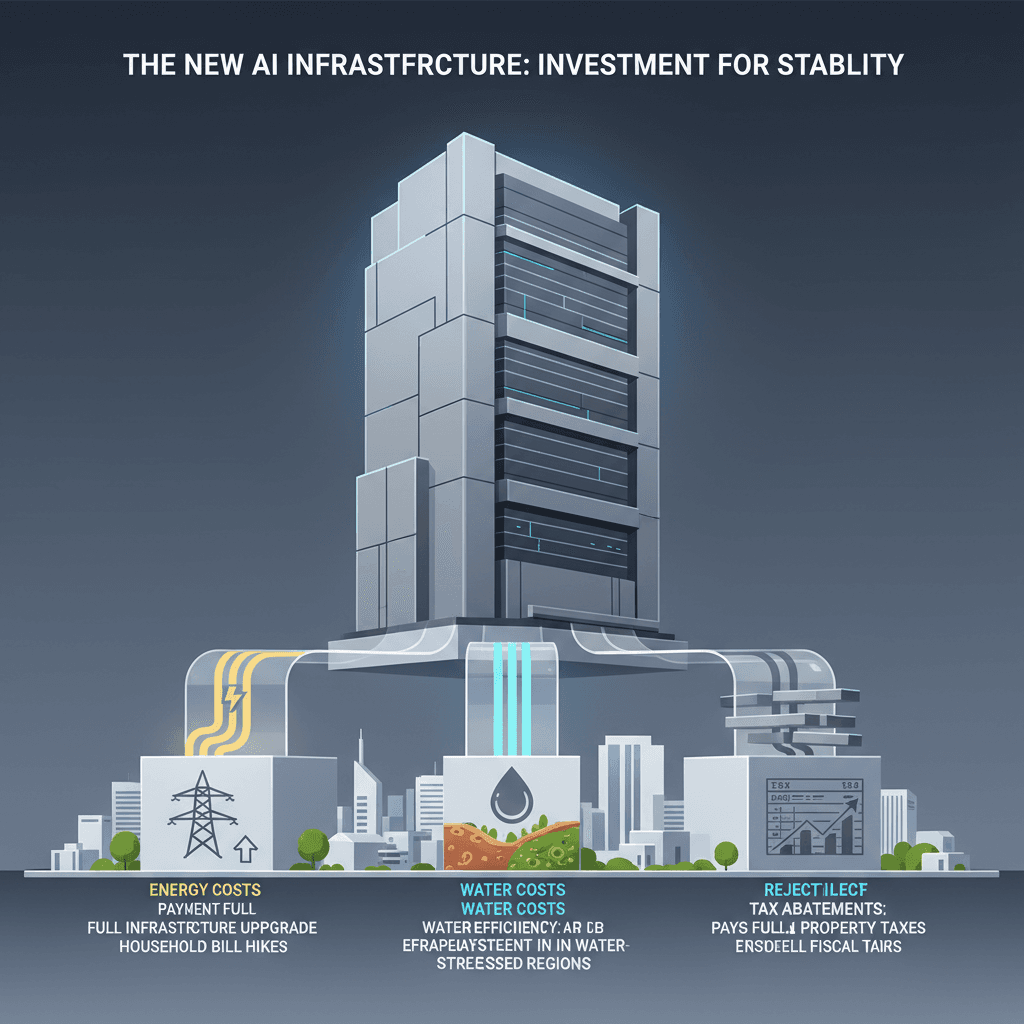
The accelerating push to build the infrastructure necessary for the artificial intelligence boom has collided with mounting local opposition across the United States, forcing one of the industry’s giants to fundamentally shift its approach. Microsoft, a principal investor in the AI revolution, has unveiled a sweeping new policy package, pledging to absorb the full financial and environmental costs of its data center operations to mitigate the strain on host communities. This landmark initiative, which the company calls “Community-First AI Infrastructure,” is a direct response to a growing wave of public frustration over escalating utility bills, stressed water supplies, and lost tax revenue in areas targeted for data center expansion[1][2][3].
The core of Microsoft’s commitment is a pledge to fully cover the power costs of its massive AI data centers, a move intended to ensure that local residents will not face higher electricity bills as a result of the facilities' immense energy consumption[4][1]. This issue has become a flashpoint in data center hubs across the nation, with residential electricity prices in regions like Virginia, Illinois, and Ohio climbing 12 to 16 percent faster than the national average in the past year, as grid operators struggle to add the necessary capacity[4][2]. To address this, Microsoft will now actively ask utility companies and public utility commissions to set higher rates for its data centers, ensuring the company pays the full cost of usage and the infrastructure upgrades required to support its substantial demands, thereby preventing these expenses from being passed on to households[1][3][5]. The company’s president and vice chair, Brad Smith, acknowledged that the industry’s operating model from the first half of the decade is “not an appropriate path for the second half,” indicating a recognition that the economic burden can no longer be outsourced to the public[6][7].
Beyond electricity, the "Community-First" plan tackles other major concerns that have fueled community pushback. Water consumption has emerged as a critical environmental flashpoint, especially as data centers, which require vast amounts of water for cooling, are often sited in drought-prone or water-stressed regions like Arizona, Nebraska, and Wyoming[1][8]. The initiative includes a commitment to achieve a 40 percent improvement in water efficiency by 2030, alongside a pledge to replenish more water than is withdrawn in each region where it operates[1][3][9]. This commitment to being "water positive" aligns with similar long-term goals of other tech giants, but Microsoft's public declaration of publishing water-use data for each U.S. data center region, along with progress on replenishment efforts, signals a new level of intended transparency and accountability[1][8][10].
The initiative also directly addresses fiscal concerns often raised by local governments and citizens. Historically, tech companies have sought and received significant property tax abatements for data center construction[9]. Microsoft has now pledged to reject local property tax breaks, promising to pay the full property tax rate at all its U.S. data center sites[1][2]. This commitment aims to silence the argument that while data centers provide some economic activity, they ultimately drain resources and diminish the local tax base without generating significant local employment, since the facilities are often highly automated once operational[3][11][12]. Furthermore, the company will invest in AI literacy training for local schools, libraries, and small businesses, and is committing to training local residents for construction and maintenance jobs[3][13].
Microsoft’s recalibration has been hastened by an increasingly volatile political landscape. The issue of soaring utility costs and data center expansion has drawn bipartisan attention, ranging from conservative towns in Oklahoma petitioning against local officials to progressive lawmakers like Senator Bernie Sanders, who has called for a national moratorium on new data center construction[14][15][16]. The pressure intensified when President Donald Trump publicly addressed the issue, stating that technology companies must “pay their own way” and should not leave consumers to “pick up the tab” for data center energy use, further politicizing an already charged local debate[1][3][10]. Microsoft’s comprehensive announcement, framed as a "civic responsibility," arrives as the industry fears that prolonged community and political pushback could delay or block the construction of infrastructure deemed critical for competing in the global AI race[6][7].
The move sets a new, demanding benchmark for the entire AI and cloud computing sector. Other hyperscale operators like Google, Amazon, and Meta, which have also faced escalating community opposition and project delays over the same issues, have largely avoided public comment on the mounting resistance[11][12]. While all the major players have ambitious climate pledges, including being "water positive" by 2030, the exponential energy demand from AI is testing the credibility of those commitments, with some companies reporting substantial increases in emissions driven by data center electricity[17][18][8]. The sheer scale of AI infrastructure build-out is immense; IEA estimates project that AI data center demand could triple U.S. electricity use to 640 terawatt-hours by 2035, underscoring the necessity for systemic changes[5]. Microsoft's standardization of its commitments across its domestic portfolio signifies an acknowledgment that securing the infrastructure for AI requires a fundamentally different and more accommodating relationship with local communities. This pivot from seeking maximum efficiency and tax breaks to one of transparently absorbing all external costs may be the necessary trade-off for the AI industry to sustain its explosive growth and maintain social license to operate[19][9].
Sources
[2]
[3]
[5]
[6]
[9]
[11]
[12]
[19]