
Meta Secures 6.6 Gigawatts of Nuclear Power to Fuel AI Dominance
Meta bets 6.6 gigawatts on nuclear power, funding both aging plants and advanced reactor startups to secure AI dominance.
January 9, 2026
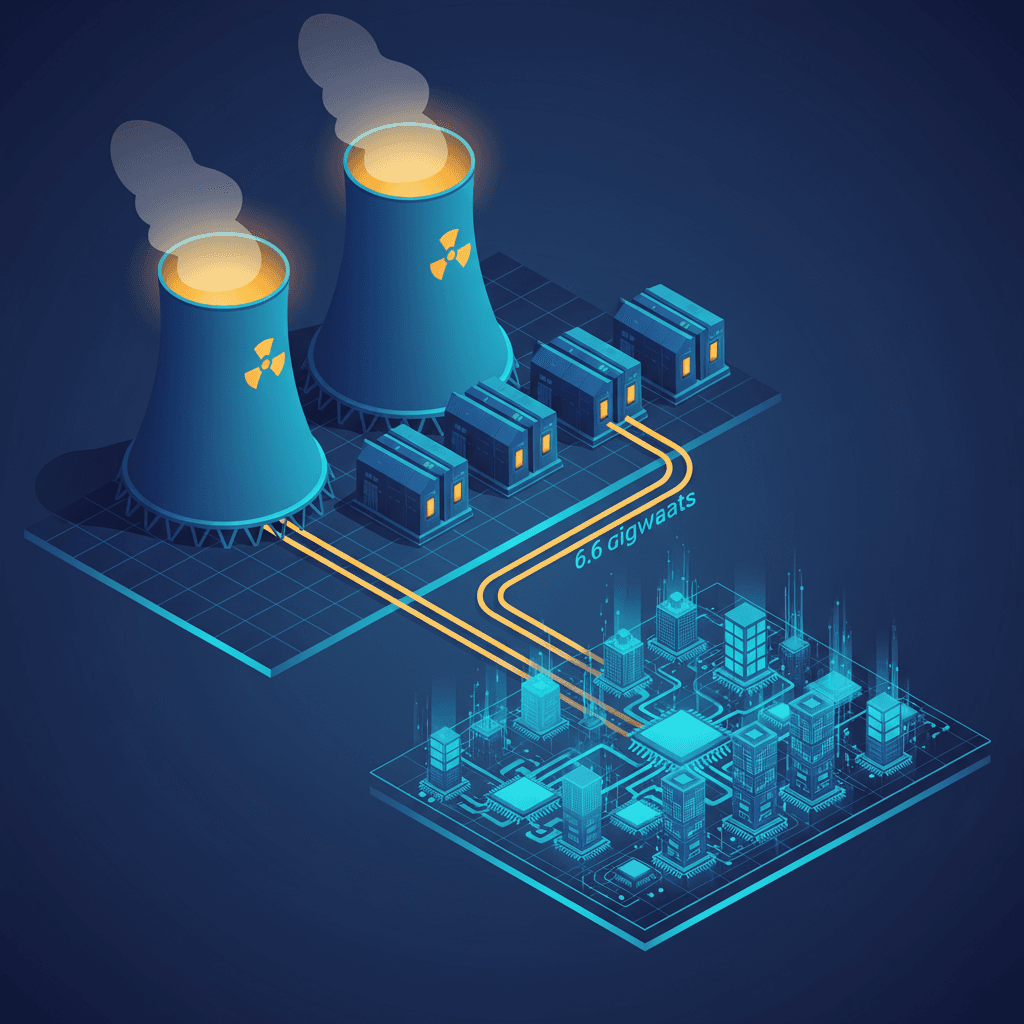
Meta Platforms has dramatically reshaped the landscape of corporate energy procurement and AI infrastructure with its commitment to secure up to 6.6 gigawatts of nuclear power capacity by 2035. The colossal energy expansion, which positions the social media giant as one of the most significant corporate purchasers of nuclear energy in American history, is a direct response to the unprecedented and burgeoning power demands generated by the company's aggressive pursuit of artificial intelligence dominance. The strategy is built on a dual approach: securing long-term power from existing nuclear assets and providing catalytic funding for next-generation reactor technologies, marking a profound inflection point in how Big Tech plans to fuel its computational future.[1][2][3][4][5][6]
The multi-pronged nuclear initiative centers on landmark agreements with three distinct energy companies: Vistra, Oklo, and TerraPower. For immediate and near-term stability, Meta has secured 20-year power purchase agreements with Vistra to draw energy from three existing nuclear plants located in the US heartland. This includes the Perry and Davis-Besse plants in Ohio and the Beaver Valley facility in Pennsylvania. The deal guarantees access to more than 2.1 gigawatts of operating generation capacity and provides crucial financial support for a combined 433 megawatts of generation output increases, known as uprates, at these three sites. These uprates represent the largest supported by a corporate customer in the US and are integral to extending the operational lifespan of the reactors, with existing licenses running until at least 2036 and one Beaver Valley unit licensed through 2047. By supporting the continued operation and expansion of existing plants, Meta secures a reliable, low-carbon energy stream critical for powering its current and planned data center infrastructure.[4][1][6][5][7]
Beyond life-extension for existing facilities, Meta is making a high-conviction bet on the future of nuclear technology by funding two prominent developers of Small Modular Reactors (SMRs) and advanced nuclear designs. In a significant deal, Meta partnered with Oklo, a company notably backed by OpenAI CEO Sam Altman, to advance the construction of a 1.2 gigawatt advanced nuclear technology campus in Pike County, Ohio. This site is slated to directly support Meta's data centers in the region, with the first power delivery targeted as early as 2030. To accelerate this ambitious timeline and ensure project certainty, Meta will prepay for power and provide upfront funding specifically intended to help Oklo secure nuclear fuel and deployment of its Aurora powerhouse technology. Concurrently, the tech giant is also funding TerraPower, a firm supported by Bill Gates, to develop its advanced Natrium reactor and energy storage system. This agreement includes funding for two new Natrium units capable of generating up to 690 megawatts of firm power, with delivery possible as early as 2032. Furthermore, the deal grants Meta the rights to energy from up to six additional Natrium units, bringing the total potential generation from TerraPower to 2.8 gigawatts by 2035. This long-dated, capital-intensive investment underscores a strategic effort to cultivate a next-generation power supply that can scale with the anticipated exponential growth of its AI computations.[2][6][1][4][8][5]
The urgency behind this massive energy pivot is the insatiable power appetite of artificial intelligence. Training and running increasingly sophisticated large language models and other generative AI services requires enormous computational power, which translates directly into surging electricity demand for the colossal data centers that house the necessary high-density compute clusters. US electricity consumption is already projected to rise by at least 30% by 2030, with data centers accounting for the majority of this growth, a trend that is severely straining existing power grids. Unlike intermittent power sources like solar and wind, nuclear energy offers a "firm, baseload" supply that runs 24/7 without interruption—a critical requirement for AI data centers that cannot afford downtime. Meta’s Head of Global Energy, Urvi Parekh, explicitly stated that the company is investing in nuclear because it provides the "clean, reliable power that is essential for advancing our AI ambitions," including its goal of building "personal superintelligence for everyone." This foundational energy push is a prerequisite for Meta's infrastructural build-out, including its 1-gigawatt 'Prometheus' AI data center cluster planned for New Albany, Ohio.[9][7][10][1][6][8]
Meta's nuclear gambit has wide-ranging implications, triggering what some are calling a "Nuclear Renaissance" driven by Big Tech demand. For the previously challenged nuclear power sector, the financial backing from a major hyperscaler like Meta provides a transformative influx of capital and market certainty. The agreements with Oklo and TerraPower signal a vote of confidence and a critical financial accelerant for Small Modular Reactor technology, which promises a shift toward factory-built, less costly, and more rapidly deployable reactors, although critics still cite the challenges of achieving true economies of scale and navigating lengthy regulatory approval processes with the Nuclear Regulatory Commission. The immediate market reaction to the announcement was swift, with shares of both Vistra and Oklo surging dramatically in pre-market trading, reflecting the perceived value of securing long-term power purchase agreements from a company with Meta's vast financial resources. This strategic move establishes a new competitive front in the AI race, where control over a reliable, massive, and low-carbon energy supply is becoming as crucial as the underlying chip and software technology itself. Meta is not just consuming the next energy paradigm; it is directly underwriting the innovation and infrastructure needed to build it, fundamentally altering the calculus for both energy developers and its AI rivals in the process.[9][4][8][10][7]
By committing up to 6.6 gigawatts to its nuclear-powered future, Meta has demonstrated that its AI ambitions are no longer constrained by the limits of existing power grids and traditional renewable energy sources alone. This comprehensive strategy, balancing the extension of proven, low-carbon assets with the upfront funding of nascent, advanced reactor technologies, solidifies nuclear power as a foundational pillar of Big Tech’s infrastructure for the next decade and beyond. The investment not only seeks to power the company’s vast computational needs but also to shape the national energy mix, reinforcing the role of nuclear energy as a clean, continuous-supply option vital to meeting the escalating demands of the artificial intelligence era. This bold move sends a clear message that for the future of AI, a stable, carbon-free energy source is a non-negotiable strategic asset.[2][11][1][9]
Sources
[1]
[2]
[3]
[5]
[7]
[10]