
Local Resistance Stalls $98 Billion in AI Data Centers, Threatening Tech Expansion.
Local revolts driven by high energy costs and resource strain halt $98 billion in AI data centers across eleven states.
January 4, 2026
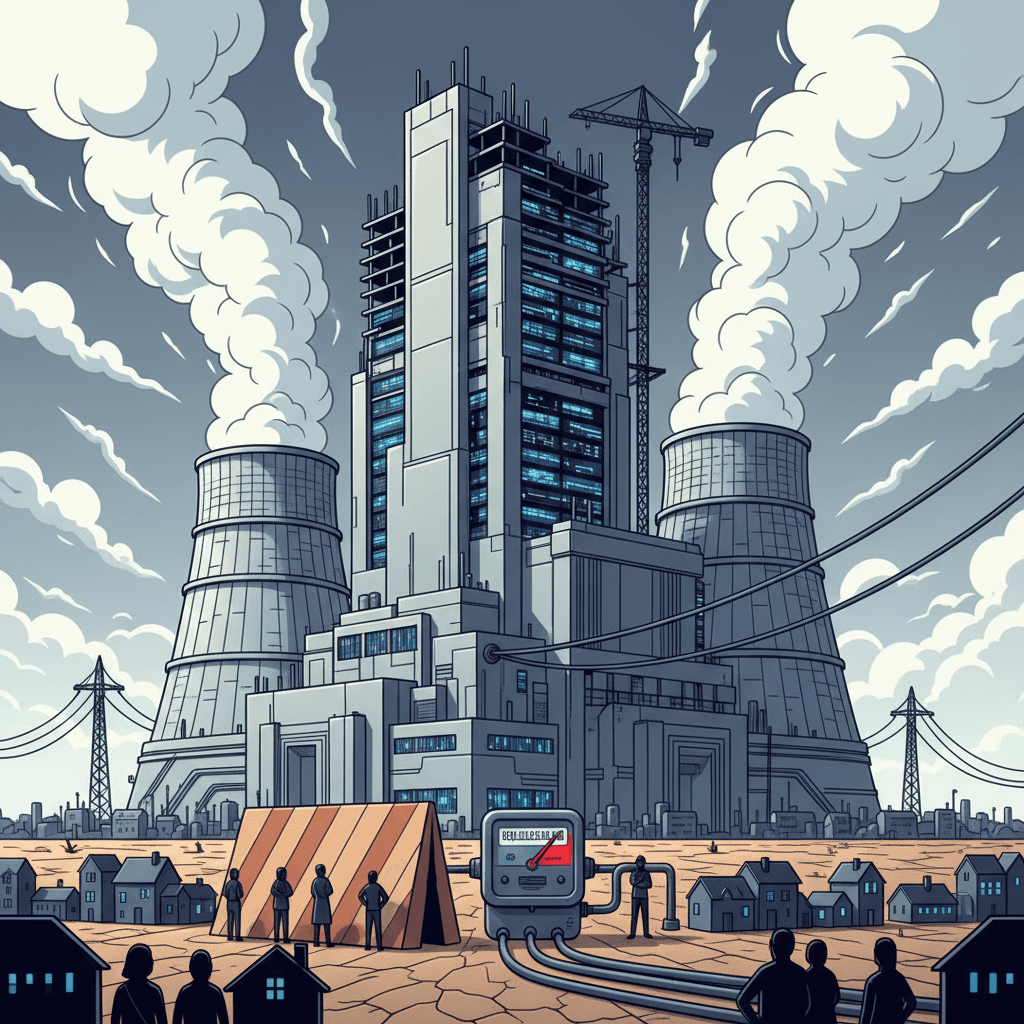
A surging wave of opposition from local communities across the United States has abruptly blocked or delayed a substantial portion of the massive infrastructure expansion required by the artificial intelligence industry, stalling approximately $98 billion worth of AI data center projects across eleven states. This grassroots resistance represents a critical inflection point for Big Tech's ambition, as two-thirds of all such projects tracked by industry observers were reportedly stalled between April and June[1]. The resistance, which spans both Republican- and Democratic-leaning states, is a clear signal that the environmental and quality-of-life impacts of AI's physical footprint are no longer being quietly accepted, threatening to reshape the industry’s development trajectory in North America[2].
The primary catalyst for the widespread pushback is the extraordinary resource consumption of these AI-focused facilities, which are often larger and more power-intensive than their cloud computing predecessors[3][4]. Data centers, essential for training and operating large language models, demand gargantuan amounts of energy and water, straining local grids and municipal supplies[1][5]. For many communities, the most pressing concern is the upward pressure on electricity bills, a consequence of data centers demanding more power than local grids can readily supply, thereby raising costs for all ratepayers[1][2][6]. Residents in states like Georgia, where one county's water use from a single major tech company's data center accounts for ten percent of the total county water consumption, fear the depletion of vital water resources, particularly in drought-prone areas[6][7]. The cooling systems alone for a major data center can evaporate millions of gallons of water daily, equivalent to the daily needs of a town of 100,000 people[8]. Beyond resource strain, residents cite noise pollution from cooling systems and backup diesel generators, loss of valuable farmland, and a reduction in property values as key factors fueling their opposition[1][5].
This local revolt has created a challenging and unpredictable regulatory environment, forcing tech giants like Microsoft, Google, Amazon, and Meta to rethink their expansion strategies[5]. What were once routine zoning approvals have devolved into protracted political battles, with local government officials facing pressure from packed community meetings and the very real risk of being voted out of office for backing the projects[1][5]. This has led to a patchwork of local moratoria and new environmental rules across the country, with over one hundred counties and cities implementing temporary halts or new regulations since 2023[9]. The political implications are becoming increasingly clear, as seen in a recent Georgia election where a candidate successfully won a statewide office by campaigning against the unchecked expansion of data centers and associated high electricity costs[2]. While many states initially courted data centers with tax incentives for their economic benefits, the rising public cost in terms of infrastructure strain and environmental impact has caused a sudden shift in sentiment, particularly in areas like Prince George's County, Maryland, which paused all new data center development to study the community impacts[7].
The collective blocking of nearly $100 billion in infrastructure represents a significant headwind for the AI industry, which relies on a constant and rapid expansion of computational capacity[1]. Companies like Google, which has plans to increase its computing capacity 1,000-fold within five years, and others pursuing massive new projects, face an unprecedented bottleneck[1]. Delays in construction due to permitting difficulties and community resistance directly impact AI development timelines, which require this new computational horsepower to train increasingly sophisticated models[10]. Furthermore, these delays exacerbate existing supply chain problems, as long wait times for critical AI-ready components like high-end GPUs and batteries mean that hardware ordered years in advance can be outdated by the time a facility is finally permitted and completed[11]. This forces operators to settle for older equipment or face costly hardware retrofits soon after going live, ultimately hampering the performance needed for AI-driven workloads[11]. While tech giants like Meta continue to announce multi-hundred-billion-dollar investment plans for AI infrastructure, the escalating local resistance ensures that securing the physical space and power to deploy that capital is now one of the most significant systemic risks to the sector[2][9].
To mitigate the growing crisis, industry representatives are now advocating for a strategic shift towards earlier and more sincere community outreach, emphasizing local economic benefits and water and energy conservation efforts[5]. However, the core challenge remains the inherently high consumption profile of AI infrastructure, which pits the world-changing ambitions of Big Tech against the quality of life and resource security of local populations[9]. The growing, bipartisan nature of the opposition—with nearly 50,000 petition signatures against specific projects collected in a single three-month period—suggests that this is not a transient issue but a fundamental challenge to the long-term sustainability and physical model of AI's rapid growth[2][9]. The industry must now navigate this new reality, which demands a greater commitment to energy-efficient designs, the utilization of more advanced closed-loop cooling systems, and a more equitable integration with the communities they seek to inhabit, or risk a protracted slowdown in the buildout of the AI-enabling digital infrastructure[7][4].