
Labeling AI Ads Drops Click-Through Rates by a Massive 31.5 Percent
AI-created ads excel when hidden, but disclosure triggers a profound consumer aversion, slashing clicks by nearly one-third.
December 20, 2025
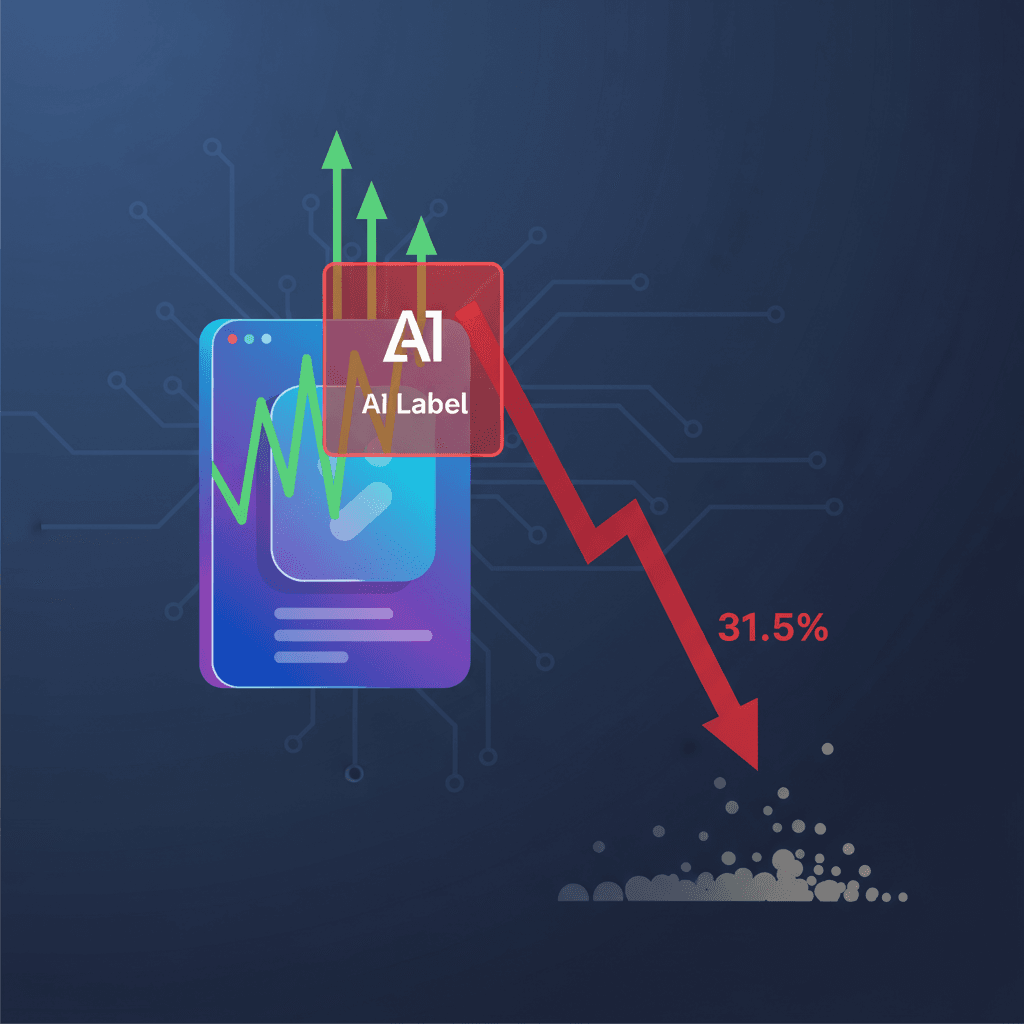
A groundbreaking study from researchers at NYU and Emory University has delivered a clear and potentially challenging message to the advertising industry: explicitly labeling an advertisement as AI-generated causes its click-through rate (CTR) to fall off a cliff, dropping by a significant 31.5 percent compared to human-created benchmarks.[1][2][3][4] The findings underscore a massive disconnect between the demonstrable effectiveness of generative AI and prevailing consumer skepticism toward the technology, creating a critical dilemma for brands navigating the evolving landscape of digital content transparency.[1][3][4]
The research, detailed in the paper *The Impact of Visual Generative AI on Advertising Effectiveness* by Hyesoo Lee, Vilma Todri, Panagiotis Adamopoulos, and Anindya Ghose, investigated three main creative approaches: ads created entirely by human experts, ads created entirely by visual generative AI (genAI), and human-created ads that were then *modified* using genAI tools.[5][3][4] The study utilized a mixed-methods design, including a field experiment on the Google Display Network, which provided real-world performance data across billions of ad impressions.[3] The results show that when consumers are unaware of the tool’s involvement, fully AI-generated advertisements consistently and substantially outperform their human counterparts, achieving an impressive 19 percent higher click-through rate.[1][3][4] This performance boost highlights the raw power of large visual models to generate highly optimized, aesthetically pleasing, and engaging ad content at scale.[4] The mechanism behind this success appears to be the AI-created ads' ability to elicit stronger emotional engagement and achieve higher *visual processing fluency*, meaning the human brain processes the image with greater ease, which in turn drives a higher propensity to click.[3]
However, the effectiveness of generative AI proves to be asymmetrical, revealing a distinct preference for its use as a holistic, blank-slate creator rather than an editor. The study found that advertisements which were merely "genAI-modified"—where AI was used to enhance or tweak existing human designs, perhaps changing a background or adjusting an element—showed no significant improvement over the original human-made ads.[3][4] In fact, other parts of the research indicated that this modification approach, where the AI is constrained by an existing visual, can actually decrease consumer purchase intention.[2][4] This is a crucial finding that runs counter to the common marketing workflow of using AI to refine human concepts. Researchers trace this back to the phenomenon of *output constraints*, suggesting that when genAI is forced to work within predefined visual boundaries, it struggles to maintain what the paper calls "ecological validity," making the resulting ad look less authentic or coherent to the consumer.[3][4] The implication is clear: generative AI delivers its greatest value when unconstrained, acting as an idea generation engine from the very beginning of the creative process.[1][4]
The most immediate and impactful revelation for the industry is the dramatic cost of transparency. The 31.5 percent drop in CTR upon disclosure—which applied regardless of the image’s actual appearance or quality—quantifies a profound psychological aversion to machine-made content in the realm of commercial persuasion.[2][3] This negative consumer bias is not an isolated finding; it aligns with parallel research indicating that consumers become more skeptical and less engaged when they know content is AI-generated, often perceiving such ads as less natural, less useful, and even experiencing a "negative brand halo."[6][7] Furthermore, a significant portion of the public already believes that ads should carry a label when AI is used, highlighting a growing tension between consumer desire for transparency and the measured negative impact on advertising performance.[8] While the negative bias is stronger for ads promoting more traditional products, the pushback is lower for innovative, high-tech offerings, suggesting the context of the product can moderate the consumer's reaction to the AI source.[6]
The implications of these findings are substantial for the future of digital marketing and the rapidly evolving regulatory environment. The study essentially presents brands with a direct trade-off: higher effectiveness and performance through undisclosed AI usage, or adherence to the growing global push for transparency, a choice that demonstrably results in a significant business penalty.[1][4] The findings are particularly relevant in light of developing policies, such as the European Union’s AI Act, which will mandate disclosure for AI-manipulated content.[1][4] The research suggests that without careful strategy, complying with these mandates could directly and substantially reduce the return on investment for generative AI in advertising.[4]
Ultimately, the study paints a complex picture for the adoption of AI in the creative industries. While the technology is proven to generate superior visual content when used with creative freedom, its very identity poses a problem for consumer trust and action.[3][4] The future of the industry may not be a simple replacement of human designers, but rather the establishment of a sophisticated hybrid workflow. This model would leverage genAI as an unconstrained, high-volume ideation and creation engine, while still relying on human experts for final creative selection, brand consistency, and, critically, navigating the ethical and legal labyrinth of disclosure. The long-term challenge for brands will be to find a way to communicate the value of AI-driven efficiency without triggering the unconscious aversion that cuts clicks by nearly one-third.[1][3]