
GitHub Releases Copilot SDK: Unleashing Agent-Driven Development for the Enterprise.
The SDK embeds the production-tested Copilot execution core, accelerating the shift toward autonomous, intent-driven application development.
January 23, 2026
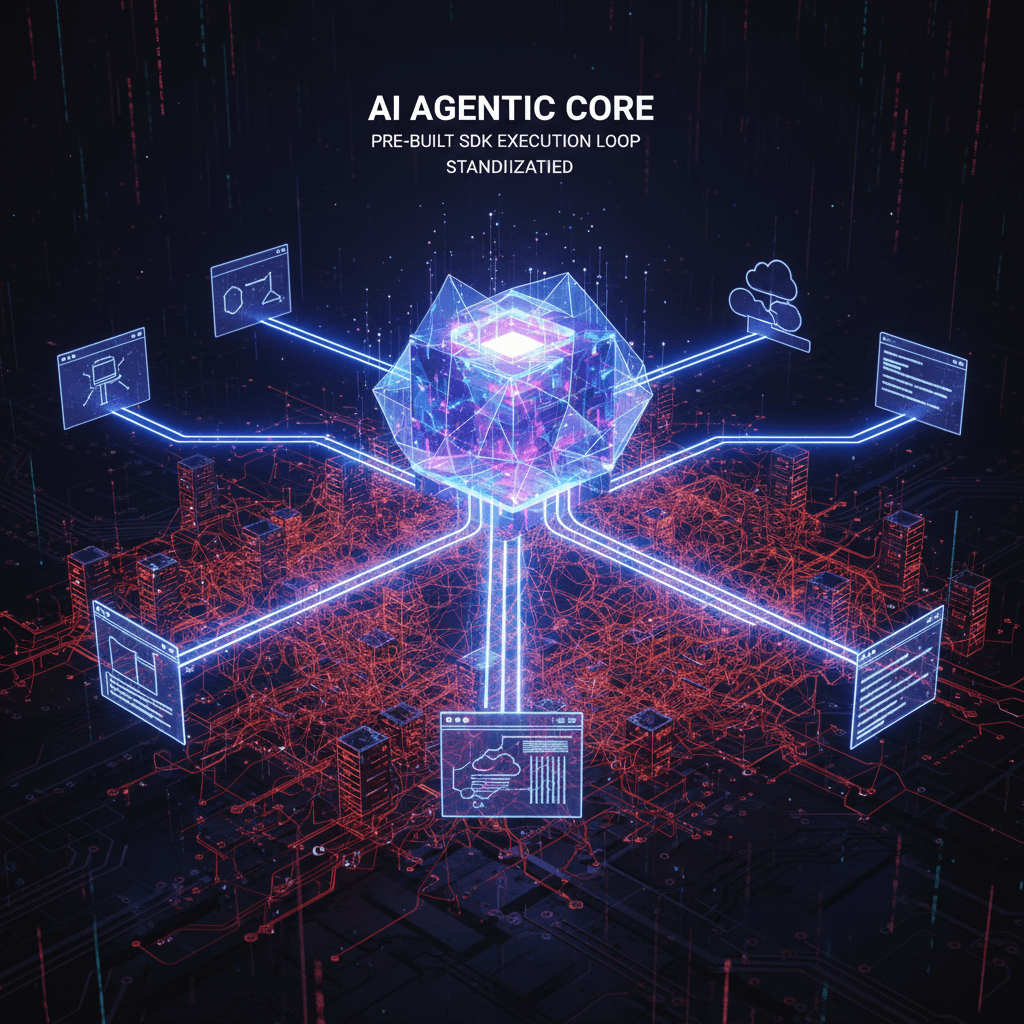
The release of the GitHub Copilot SDK marks a significant inflection point in the shift toward agent-driven development, providing a powerful, pre-built execution framework for embedding sophisticated AI agents directly into a vast array of applications. This strategic move by GitHub is designed to democratize access to the production-tested "agentic core" that powers tools like the GitHub Copilot Command Line Interface, thereby abstracting away the immense complexity traditionally associated with building custom AI planners, multi-model orchestrators, and runtimes from scratch. By offering programmatic access to this core engine, the Copilot SDK enables developers to transition from the current paradigm of syntax-driven development to a more intent-driven workflow, where complex, multi-step tasks are delegated to an autonomous AI agent layer. Available in technical preview with support for major ecosystems including Node.js/TypeScript, Python, Go, and .NET, the SDK positions GitHub as an essential infrastructure provider in the burgeoning AI agent market, projected to reach a valuation of over $52 billion by 2030, reflecting a rapid industry adoption where a high percentage of Chief Information Officers are already planning agent deployments within the next two years.[1][2][3]
The technical value proposition of the Copilot SDK lies in its ability to provide a complete, robust agentic loop right out of the box, eliminating the need for developers to manage complex infrastructure themselves. Building agentic workflows typically requires developers to independently engineer systems for managing context across conversational turns, orchestrating various tools and commands, routing requests between different large language models, integrating with specialized services like the Model Context Protocol (MCP) servers, and meticulously handling permissions, safety boundaries, and failure modes.[1] The SDK removes this considerable burden by allowing the embedding of the same execution loop that handles planning, tool invocation, file edits, and running commands in the Copilot CLI.[1][3] This integrated approach means that developers gain immediate access to production-grade capabilities, including multi-model support, custom tool definitions, secure GitHub authentication, and real-time streaming, which are all managed by the underlying Copilot infrastructure.[1][2] The architectural design employs a JSON-RPC model where the SDK client in the application communicates with a Copilot CLI server, which the SDK client can manage automatically or connect to externally for distributed enterprise deployments.[2][3]
A core feature of the SDK is the seamless integration of custom tools, which allows developers to define domain-specific functionalities that the Copilot agent can invoke autonomously during a multi-step conversation. This custom tool execution is fundamental to transforming the general-purpose Copilot core into a specialized agent tailored for specific application needs.[2][4] For instance, an agent embedded in a desktop application could be given a custom tool to interact with local files or system-level commands, or an enterprise application agent could be equipped with tools to interface with proprietary databases and internal APIs.[1] Furthermore, the SDK supports multi-turn conversations, ensuring the agent maintains session history and context-awareness throughout complex interactions.[4] By default, the SDK enables all first-party tools, granting the agents a wide range of actions, including file system operations, Git operations, and web requests, but the developer maintains full lifecycle control over the client and session states.[3][4] This level of control, combined with the Model Context Protocol integration, allows organizations to tailor the agent’s behavior, memory, and knowledge base, which has been shown to yield tangible developer productivity gains, such as a 7% increase in pull request merge rates for the Copilot coding agent.[2][5]
The implications of the Copilot SDK extend far beyond simple code generation, accelerating the industry-wide migration towards fully agentic software ecosystems. The SDK’s availability signifies GitHub's strategic move to become the central, standardized platform for AI agent development, comparable to its existing role as the standard for code hosting and collaboration.[2] This initiative enables a new wave of practical AI-powered applications, demonstrated by internal projects already built using the SDK, such as YouTube chapter generators, custom graphical user interfaces for AI tasks, and voice-to-command workflows for running desktop applications.[1][6] Critically, by handling the heavy lifting of context management, model orchestration, and error handling, the SDK allows developers to focus exclusively on creating the unique, domain-specific logic that differentiates their applications.[6] This standardization of the agent runtime is likely to foster a rapid proliferation of custom agents, which can be further extended through community-driven efforts that are already creating bindings for additional languages like Rust and Java, demonstrating the enthusiasm for embedding Copilot's capabilities across the entire software spectrum, including into tools like Apache JMeter.[7] The release of the Copilot SDK solidifies the company’s vision of a future where developers collaborate with AI agents in a configurable, steerable, and verifiable manner, ensuring that organizations can embrace these new autonomous workflows without compromising their security posture.[8] This is an infrastructural move that transforms an intelligent coding assistant into a ubiquitous, programmable execution platform, setting a new benchmark for how AI is integrated into application development across the enterprise landscape.[1][2]
Sources
[1]
[2]
[3]
[4]
[5]
[6]
[7]