
Foxconn hires 30,000, solidifying India’s status as Apple’s core pillar.
The Bengaluru factory combines massive immediate employment with a strategic long-term shift toward AI-driven manufacturing.
December 22, 2025
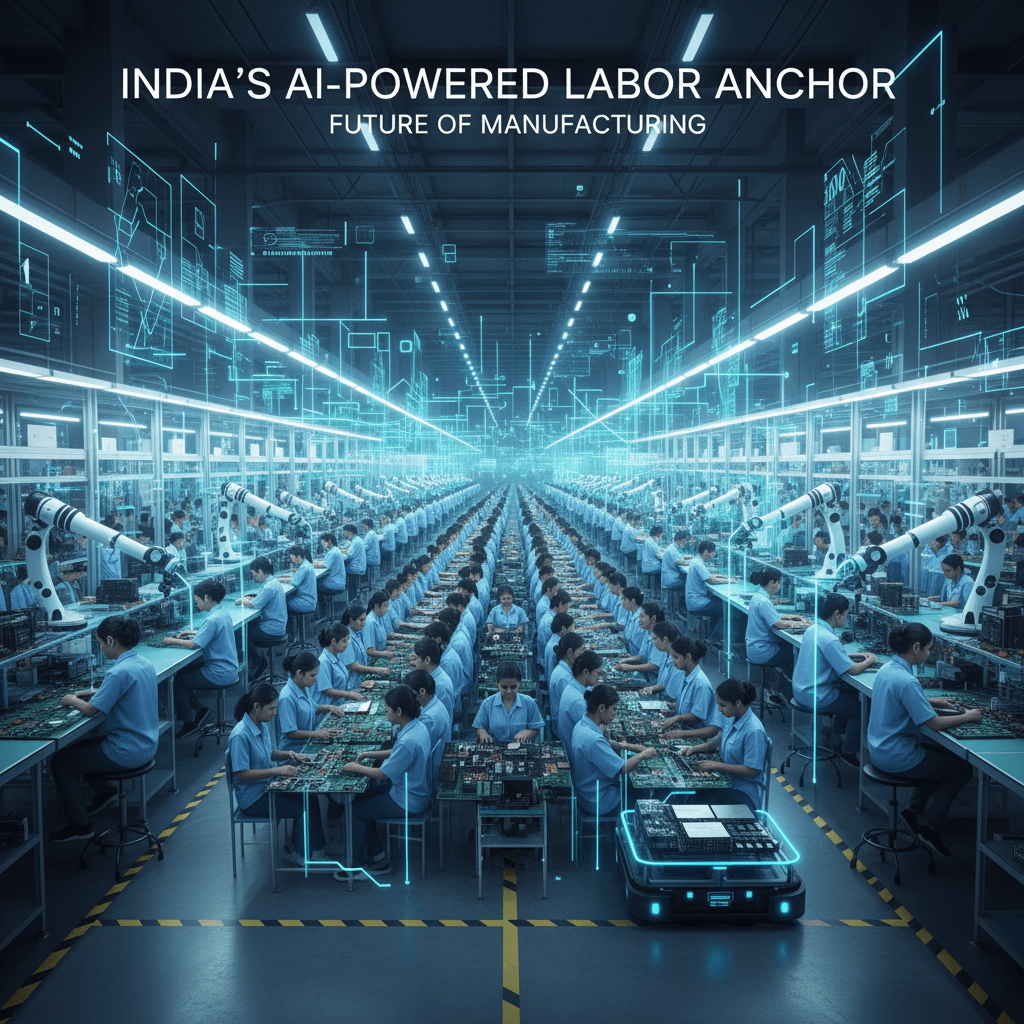
A massive, unprecedented hiring drive by the Taiwanese electronics giant Foxconn has cemented India's status as a critical manufacturing pillar in Apple's global supply chain. The company has brought on board nearly 30,000 new workers at its vast iPhone assembly plant near Bengaluru, a phenomenal ramp-up completed in just eight to nine months, setting a new benchmark for factory mobilization in India's industrial sector. This rapid scaling, part of a staggering 20,000 crore rupee (approximately $2.4 billion) investment in the project, underscores a fundamental and accelerating strategic pivot by Apple to diversify its production footprint away from its long-established base in China.[1][2][3][4] The facility, located in Devanahalli and spanning 300 acres, began test production with the iPhone 16 models and has quickly progressed to assembling the latest, high-end iPhone 17 Pro Max devices.[1][2][3][4][5][6] A critical indicator of India’s new role is the high export volume, with reports indicating that over 80% of the plant's output is being shipped overseas, reinforcing the nation's rising prominence as an international electronics manufacturing hub.[1][2][3][4][5][6]
The monumental recruitment effort is poised to reshape the socio-economic landscape of the region while highlighting India's emergence as a viable alternative for high-volume, precision electronics manufacturing. The Devanahalli factory’s workforce is notable for its demographic composition, with approximately 80% being women, many of whom are first-time workers typically aged between 19 and 24.[1][2][3][4][6] This represents a significant trend in formal employment for women in the country’s blue-collar sector, with workers receiving free accommodation, subsidised meals, and a reported average monthly salary of around ₹18,000, which is positioned among the highest for women in such roles.[2][3][4] To support this workforce, which is expected to swell to up to 50,000 people at peak capacity, the company has constructed numerous large dormitories, transforming the area into what is anticipated to become a mini-township complete with residential, medical, and recreational infrastructure.[1][2][3][4][5][6] This massive employment generation aligns directly with the central government’s Production Linked Incentive (PLI) scheme, an initiative designed to attract large-scale electronics manufacturing and boost India's share of global production, though the ultimate output value and local content targets tied to the subsidies remain publicly undisclosed.[1][2][7][8] The Karnataka facility, once fully operational with up to a dozen iPhone assembly lines—up from around four currently—is projected to surpass Foxconn's existing, long-standing iPhone facility in Tamil Nadu in both production capacity and total employment.[1][2][3][4][7][6]
While the immediate focus is on labor-intensive assembly, Foxconn's larger, long-term global strategy, which includes its expanding Indian footprint, is deeply interwoven with the future of Artificial Intelligence (AI) and automation. The company has publicly outlined plans to move towards full factory automation, leveraging generative AI and robotics to streamline workflows and reduce the reliance on low-skilled manual labor globally.[9] Foxconn’s chairman has indicated that AI-backed software can perform a significant percentage of the work required to set up a new production line, while the company is also developing its own AI model, dubbed FoxBrain, to create "Agentic workflow for very domain specific applications."[9] The speed and precision with which Foxconn has replicated its manufacturing lines in a new geographical location like Bengaluru—a capability it attributes in part to the use of AI tools like digital twin technology in planning and simulation—signals a broader industrial shift.[10][9] This digital twin technology, created in partnership with technology leaders, allows for the tracking and replication of complex production processes with unprecedented speed, ensuring unified quality standards in strategic markets worldwide, a capability crucial for rapidly shifting global supply chains in response to geopolitical and tariff pressures.[11][10]
Furthermore, Foxconn’s other strategic moves in India directly point to a coming integration of advanced technologies. The company is simultaneously expanding its Industrial IoT (IIoT) and hardware presence through its subsidiary, Ennoconn, which specializes in industrial automation and digital transformation.[12][8] This initiative, separate from but complementary to the iPhone assembly operations, aims to bring industrial PCs and AI-led technologies into the manufacturing ecosystem, enabling smarter automation, data-driven maintenance, and enhanced quality control.[13][12] This dual-track approach—massive human employment now coupled with foundational AI and automation investments—positions India not just as a location for high-volume assembly, but as a nascent center for intelligent manufacturing.[13] The eventual integration of these AI-powered systems is expected to pivot the labor requirement toward high-value technical positions, a transition that will necessitate significant upskilling and a shift in the nature of jobs from assembly-line worker to maintenance, testing, and inspection technician, even as overall factory headcount is projected to be massive for the immediate future.[13][9]
The successful, rapid ramp-up in Bengaluru highlights the profound implications of this global manufacturing shift. It solidifies Apple's resilience against geopolitical risks while validating India's industrial policies and its ability to mobilize a massive, disciplined workforce.[2][11][14] The factory’s nearly 30,000 new jobs represent an immediate and powerful economic boost, transforming local livelihoods and supply chain dynamics.[2][4] More broadly, the long-term strategic investments in automation and AI tools for manufacturing process replication foreshadow a future where high-volume electronics production, including that of iPhones, will be increasingly facilitated and optimized by sophisticated AI platforms, making the ability to rapidly deploy and manage smart factories a core competitive advantage in the global market.[10][9] India's role in this transition is therefore two-fold: an anchor for traditional, large-scale assembly today and a critical proving ground for the deployment of Foxconn's next-generation AI-driven manufacturing systems tomorrow.[13][10][9]