
DeepMind and Boston Dynamics Partner to Deploy Intelligent Atlas Factory Robots.
DeepMind's Gemini AI is integrating into Boston Dynamics' electric Atlas, accelerating intelligent humanoid robots into industrial manufacturing.
January 6, 2026
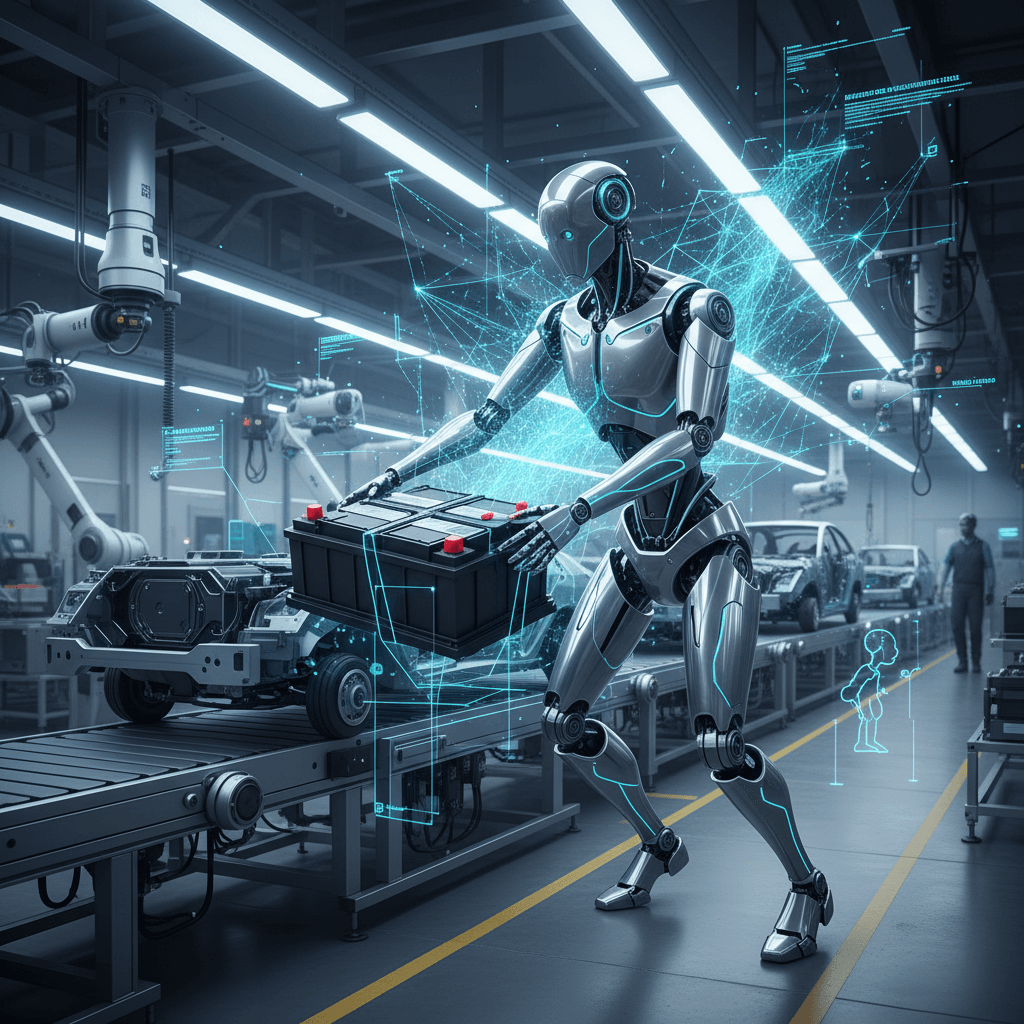
A landmark partnership between two titans of technology, Google DeepMind and Boston Dynamics, is poised to accelerate the deployment of intelligent humanoid robots from research laboratories into the heart of heavy industry, beginning with a strategic focus on automotive manufacturing. The collaboration, which was announced to considerable fanfare, centers on integrating Google DeepMind’s advanced Gemini Robotics AI foundation models into Boston Dynamics’ newly unveiled, production-ready Atlas humanoid robot, effectively merging the world’s most advanced robotic hardware with a cutting-edge brain for embodied intelligence. This move represents a major inflection point in the robotics industry, transforming the perception of humanoid machines from high-tech spectacle into a viable, scalable workforce solution. The joint effort is intended to give the athletic Atlas the cognitive power necessary to navigate and perform complex, non-repetitive tasks in the chaotic, unstructured environments of factories and warehouses, marking a substantive leap toward commercially viable, general-purpose humanoid robots.
The core technological synergy of this alliance lies in pairing the formidable physical capabilities of the new Atlas with the sophisticated perception and reasoning of the Gemini Robotics models. Boston Dynamics has moved away from the hydraulic system of previous prototypes, introducing a fully electric Atlas product version engineered for reliability, serviceability, and consistent performance in industrial settings. This next-generation robot boasts impressive specifications for real-world work, including 56 degrees of freedom for extensive range of motion, human-sized hands embedded with tactile sensors for precise manipulation, a reach extending to 2.3 meters, and the strength to lift payloads up to 50 kilograms[1][2]. Crucially, its design allows for continuous operation, featuring an onboard system that can autonomously swap its own battery in under three minutes[2][3]. However, exceptional hardware requires equally exceptional intelligence to move beyond pre-programmed routines. This is where Google DeepMind's Gemini Robotics foundation models become the game-changer, built on the multi-modal architecture of Gemini to serve as a Vision-Language-Action (VLA) system[4][5]. These models are designed to enable *embodied* reasoning, allowing Atlas to process visual inputs, understand natural language instructions, and translate that understanding into complex, real-time physical actions[6][7][4]. For the first time, a robot of Atlas’s physical caliber gains the ability to generalize its behavior to novel situations, break down a high-level goal into executable sub-steps, and continuously monitor its environment to adjust its actions accordingly, a critical feature for safely and efficiently operating alongside human workers on a dynamic factory floor[8][5][9].
The immediate and primary application of this supercharged Atlas platform is set squarely on transforming the manufacturing sector, with car factories designated as the initial proving ground. Hyundai Motor Group, which holds a majority stake in Boston Dynamics, is not merely a strategic investor but the first major customer and deployment partner[10][11]. The automotive giant has announced ambitious plans to integrate the new fleet of Atlas robots into its manufacturing affiliates, including at facilities like the Robotics Metaplant Application Center in Savannah, Georgia[3]. The deployment is scheduled to begin in the coming years, with initial tasks focused on essential but physically taxing duties such as parts sequencing for the assembly line[1][3]. This initial work will allow the robots to prove their reliability and efficiency in structured, repeatable material-handling tasks[12][10]. The strategic roadmap projects that by the end of the decade, Atlas’s responsibilities will be expanded to more intricate operations, including component assembly and complex tasks involving heavy loads and repetitive motions[1][10]. This phased approach underscores the reality that while the AI is powerful, a gradual, safety-conscious deployment is necessary to integrate these advanced humanoids into existing industrial ecosystems. The goal is to augment human teams, creating safer work environments by offloading tasks that lead to high rates of musculoskeletal disorders in human employees[11]. The sheer scale of the vision is notable, with Hyundai planning to deploy tens of thousands of Atlas and other Boston Dynamics robots across its affiliates by 2028[1].
The implications of this DeepMind-Boston Dynamics alignment extend far beyond a single industrial deployment, reshaping the competitive landscape of the burgeoning embodied AI industry. The partnership places immense pressure on rival companies who are also vying to commercialize their own humanoid platforms, such as Tesla’s Optimus and Figure AI’s Figure 02[4][1]. By combining DeepMind’s leading-edge AI foundation model research—which has produced highly generalizable VLA models like Gemini Robotics—with Boston Dynamics’ proven and now product-ready hardware, the two companies are establishing a powerful benchmark for what constitutes a "commercially viable" intelligent humanoid robot[6][4]. The collaboration is an emphatic validation of the model-platform approach to embodied intelligence, where an AI-centric company supplies the 'brain' and a robotics company supplies the 'body'[4][13]. This model suggests that the future of robotics will be driven less by proprietary, end-to-end systems and more by the deep integration of specialized hardware and highly sophisticated, general-purpose foundation models[6][11]. Furthermore, the talent implications are significant; Google DeepMind’s aggressive hiring drive in robotics, including the recent acquisition of Boston Dynamics' former CTO as VP of hardware engineering, underscores its commitment to dominating the physical AI space[13]. The successful deployment of Gemini-powered Atlas in a complex, real-world setting like a car factory could set the technical standard for the entire industry, forcing competitors to scramble to match the level of intelligence and generalization demonstrated by the combined platform[4].
In conclusion, the Google DeepMind and Boston Dynamics partnership represents a crystallization of years of advancements in both artificial intelligence and robotics engineering. The integration of the Gemini Robotics models into the all-electric Atlas is the critical step that bridges the gap between impressive laboratory demonstrations and the promise of a general-purpose industrial humanoid worker[6]. With a clear deployment strategy beginning in the capital-intensive automotive sector, backed by the manufacturing might and early-customer commitment of Hyundai, the collaboration provides a credible roadmap for scaling humanoid robots to production levels[10][9]. The success of Atlas in performing tasks like parts sequencing and assembly will be the ultimate litmus test for the entire embodied AI field[1][10]. This alliance signifies a new era of commercial robotics, where the machine is defined not just by its athletic ability, but by its capacity for intelligent, adaptable reasoning, promising to revolutionize global manufacturing and set the stage for humanoid robots to eventually permeate a wider array of industries and environments.