
Claude Transforms Into Action-Taking Digital Coworker Across Enterprise Workflows
Using the open Model Context Protocol, Claude becomes a digital coworker capable of executing full enterprise workflows.
January 26, 2026
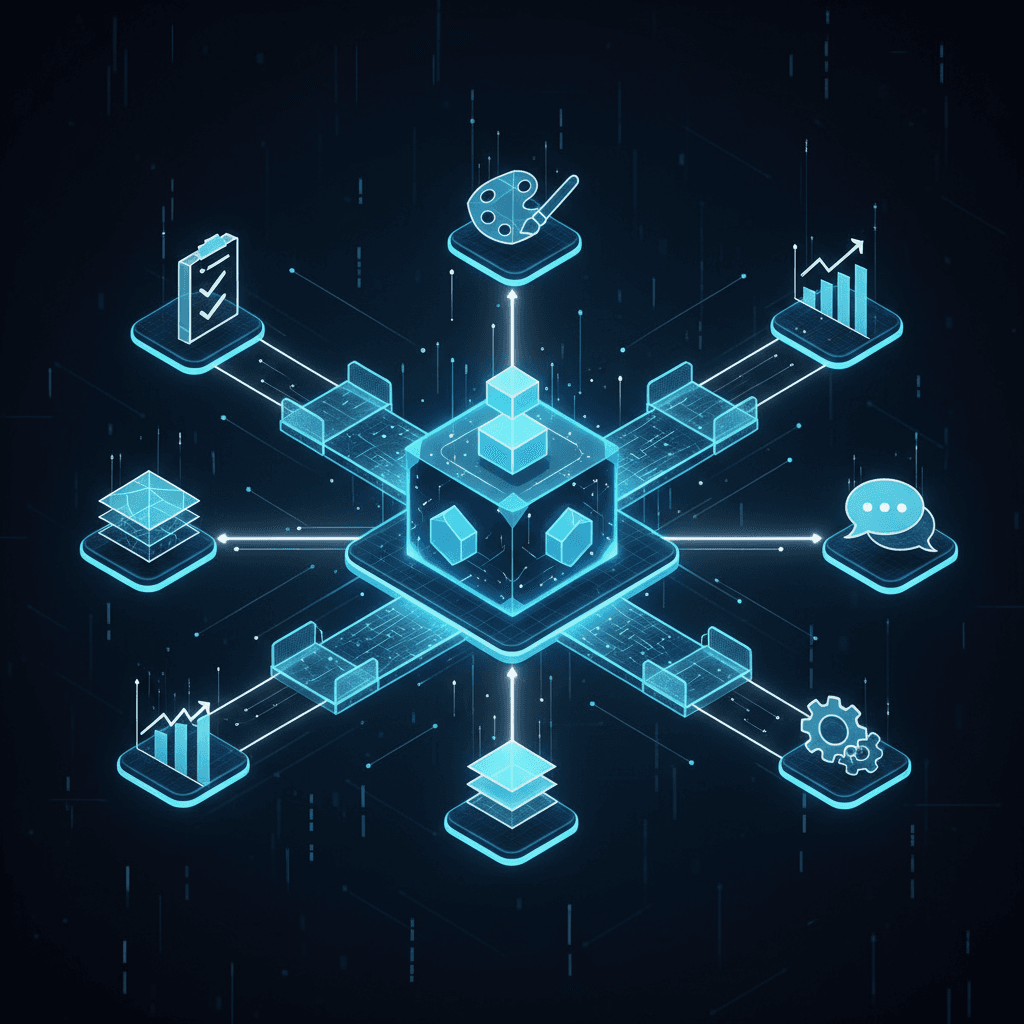
The landscape of enterprise artificial intelligence is undergoing a significant transformation as Anthropic announces a major expansion of its Claude AI, embedding it directly into the workflows of popular work tools like Asana, Figma, and Slack as interactive applications. This strategic move aims to shift Claude's role from a conversational chatbot to a true digital coworker, capable of executing complex, multi-step actions across a user's entire digital workspace. The expansion is structurally underpinned by the company's open-source standard, the Model Context Protocol, or MCP, which facilitates secure, bi-directional communication between the AI model and external software systems.
This new capability allows Claude to move beyond merely generating text or providing analysis of information that is manually fed to it. Instead, users can issue high-level, natural language commands, such as "Update our standard email template based on the new Figma designs that were posted in Slack," or "Write release notes for our latest sprint from Linear"[1][2][3]. The AI model then uses its understanding of the connected applications and their data to autonomously execute the required steps, including pulling design assets, analyzing project management tickets, and generating a final deliverable in a separate application. This transition represents a critical step in the AI industry's evolution from simple generative models to sophisticated AI agents that possess the ability to take action and update workflows directly[2][3]. The initial directory of connectors extends beyond Asana, Figma, and Slack to include other critical enterprise services like Canva, Stripe, and Notion, establishing a foundation for an increasingly integrated AI-powered workspace[2][3].
The technological core of this integration lies in the Model Context Protocol, an open standard designed to solve the "N×M integration problem" that historically plagued enterprise software connectivity[4]. In traditional software development, connecting *N* number of AI applications to *M* number of tools would require creating *N* times *M* custom integrations, quickly becoming unmanageable. MCP restructures this into an N+M problem, where each AI model and each external tool or data source only needs to conform to the MCP standard once to achieve universal interoperability within the ecosystem[4]. MCP acts as a universal connector, analogous to a USB-C port for AI applications, creating secure bridges between the large language model and external systems[5][2]. The protocol utilizes a standardized client-server architecture, enabling the AI model, the client, to access data sources, tools, and workflows—referred to in MCP as resources and tools—and, critically, to trigger actions in those external systems[6][7]. This two-way communication is a hallmark feature, allowing Claude to not just receive information but also to perform dynamic and interactive tasks, such as creating a new draft email in Gmail or updating a task in Asana[1][7].
A significant implication of the MCP approach is its contribution to improving the reliability and reducing the issue of "hallucinations" in Large Language Models. By allowing Claude to access real-time, up-to-date information directly from authoritative data sources like a company's database, issue tracker, or live documents, the model's responses are grounded in accurate and relevant external context[4]. This capability is crucial for enterprise use cases where accuracy is paramount, such as financial reporting, code generation, or legal document analysis. Furthermore, the protocol is built with security as a core principle; the AI host process controls the client connection permissions, allowing organizations to strictly manage what data the AI assistant is allowed to access and interact with[7]. This security feature is vital for fostering enterprise adoption, as it addresses major concerns around data leakage and unauthorized data access often associated with giving a powerful AI access to a company's internal ecosystem[7].
This move marks an aggressive strategic push by Anthropic into the fiercely competitive enterprise AI market, directly challenging rivals like OpenAI's partnership strategies and Google's integrated Gemini ecosystem. While other platforms have offered some form of "plugins" or "tools," Anthropic’s decision to build its entire integration strategy on an *open* standard—the Model Context Protocol—positions it as a champion for interoperability and a more decentralized AI ecosystem[8][5]. By offering an open, standardized language for LLM-tool communication, Anthropic invites broader participation from third-party developers, accelerating the rate at which new connectors and capabilities can be built into Claude[4][7]. For enterprise customers, this promises a greater degree of flexibility and a future where switching between AI models is less constrained by proprietary integration lock-in. The immediate utility for professionals, however, is a substantial leap in productivity, consolidating complex tasks that previously required manual context-switching, data extraction, and input across half a dozen different platforms into a single conversational prompt within Claude.
Ultimately, the integration of interactive apps into Claude via the Model Context Protocol is more than a feature update; it signals a maturation of the AI agent paradigm for the workplace. It transforms the AI assistant from a separate, helpful tool into the connective tissue that links disparate enterprise software into a fluid, automated workflow. The ability to directly access and manipulate data in real-time within services like Figma for design collaboration, Asana for project management, and Slack for communication places Claude at the center of the modern enterprise's operational stack, making it an informed AI collaborator that can work directly within the user's most critical tools[3]. This integration elevates the functionality of Anthropic's flagship model and establishes a new high-water mark for what businesses should expect from their generative AI partners.