
C-DAC deploys mobile quantum networks, securing moving drone platforms with QKD.
The 'Drone Quantum Kavach' breakthrough uses mobile QKD and PQC to secure defense and edge AI networks.
December 18, 2025
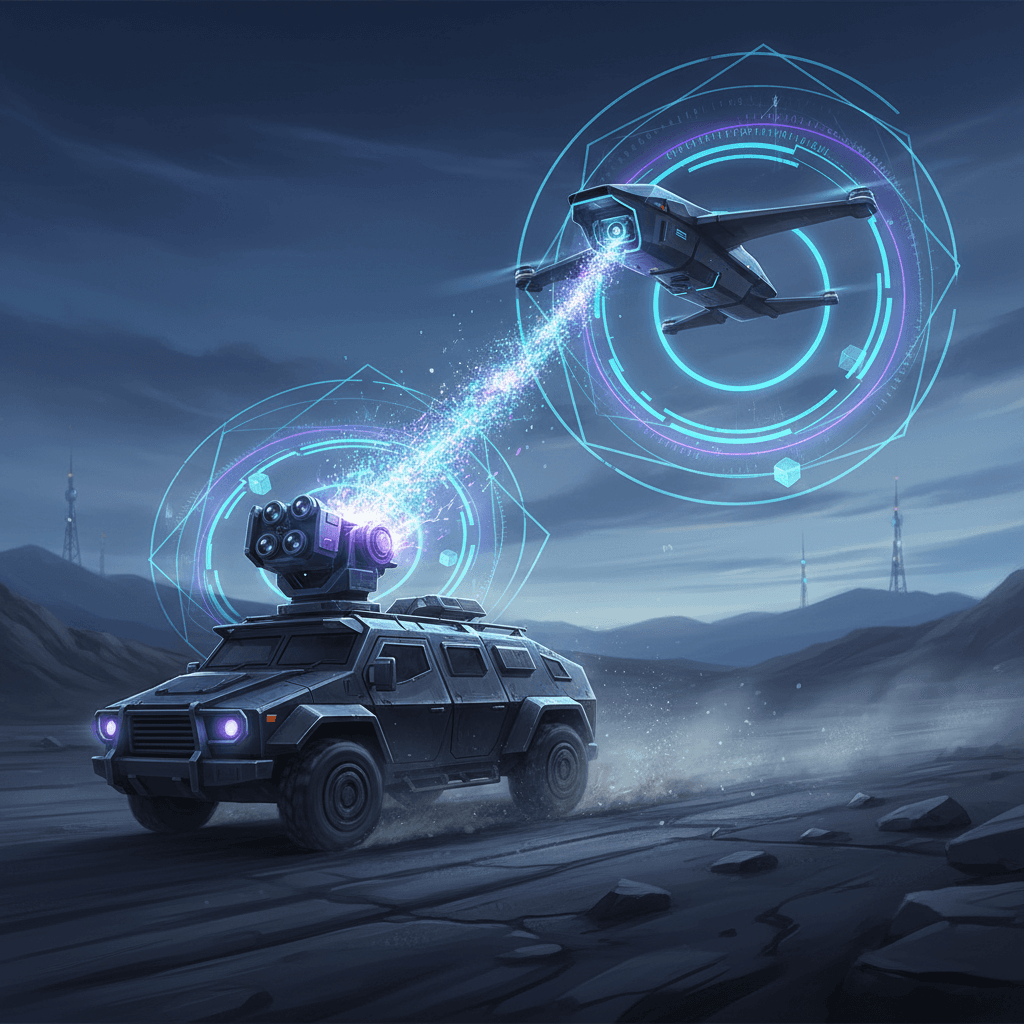
The Centre for Development of Advanced Computing, C-DAC, has achieved a critical national milestone with the successful field demonstration of a mobile quantum communication system leveraging drone-enabled platforms, marking a significant advancement toward infrastructure-independent, quantum-secure networks. This breakthrough, a key element of India’s National Quantum Mission, involved the deployment of a B92 Quantum Key Distribution, or QKD, system on a mobile platform, establishing a secure link over a 50-meter Free-Space Optical, FSO, channel while the receiver module was actively in motion. The success validates the country's growing prowess in quantum technologies and creates a path for deploying "unhackable" encryption in highly dynamic and strategic environments, such as defense, disaster response, and next-generation communication infrastructure.[1][2]
The demonstration successfully addressed the complex engineering challenge of maintaining a stable quantum link between moving nodes. The experiment was conducted by positioning the QKD receiver module on a moving vehicle, necessitating the development and use of a robust Fine Tracking mechanism to compensate for the dynamic changes in the line of sight of the atmospheric quantum channel.[2] A crucial technological component was the reliance on GPS-based precision time synchronization, which ensured the accurate timing required for exchanging single-photon quantum states. The system employed the B92 QKD protocol, which is a simplified, two-state approach to quantum key generation, generating the secure key through the atmospheric link. Performance metrics recorded during the trial indicated a stable link performance, achieving a Quantum Bit Error Rate, QBER, of approximately five percent and a Secure Key Rate, SKR, of about two kilobits per second.[1][2] This rate is a vital proof-of-concept for real-time key exchange in mobile scenarios, providing the foundation for cryptographic operations that are inherently protected by the laws of physics against any external eavesdropping attempt.
A major strategic outcome of the project is the unveiling of 'Drone Quantum Kavach,' a post-quantum secure communication solution specifically engineered for Unmanned Aerial Systems, or UAS.[1] This hybrid solution integrates the quantum-generated keys with a classical drone-based Radio Frequency, RF, link for data post-processing and secure video streaming. Beyond QKD, the 'Drone Quantum Kavach' system provides future-proof security using a hybrid cryptographic framework that is resilient against the threat of powerful quantum computers, which are expected to break current public-key encryption standards. The system’s technical specifications include the use of post-quantum cryptography, or PQC, standards like Dilithium5 for authentication and Kyber768 for key exchange, alongside AES-GCM for frame encryption.[3] By running this in-house solution on low-resource hardware like a Raspberry Pi, C-DAC has demonstrated that the technology is ready for deployment on resource-constrained platforms, a fundamental requirement for drones and other computational edge devices.[2][3]
The implications of this mobile QKD capability for the Artificial Intelligence industry are profound, particularly concerning the security of edge AI and distributed machine learning systems. Drones are increasingly serving as mobile nodes for edge computing, where AI models are deployed directly on the device for real-time tasks like surveillance, anomaly detection, and swarm coordination.[4][5] The security of the data collected by these drone-mounted AI systems, as well as the integrity of the command-and-control links, is paramount in military, tactical, and critical infrastructure applications. This mobile QKD system, coupled with the PQC-enabled 'Drone Quantum Kavach,' offers a dual-layer security solution for these platforms. It allows AI-driven drones to exchange keys with a ground station or with other drones in a swarm using a quantum channel, which is immune to eavesdropping, while the PQC layer secures the high-volume data stream—such as real-time video feeds or model updates—against future quantum hacking attempts.[3][6] This is a critical development for securing federated learning in mobile networks, where multiple autonomous AI agents need to securely exchange model parameters without revealing their underlying sensitive data.
The project aligns directly with the ambitious goals of the National Quantum Mission, NQM, a government-approved initiative with a substantial budget allocation of over six thousand crore rupees, spanning from 2023-24 to 2030-31.[7][8] The NQM aims to position the nation as a global leader in quantum technologies and mandates the development of satellite-based secure quantum communications over a range of two thousand kilometers within the country, as well as multi-node quantum networks. C-DAC, as a major partner in the NQM, is responsible for advancing both quantum computing and quantum communication capabilities.[9][7] The successful mobile QKD demonstration serves as a crucial building block, proving the capability to manage the last-mile connectivity challenges in the atmosphere, which is essential for establishing resilient quantum networks across diverse and difficult terrains, and is a foundational step towards connecting to a future quantum satellite network.[2][10] The work supports the national objective of developing indigenous, resilient, and agile quantum communication capabilities for strategic applications, representing a critical step toward securing the nation's digital and defense future in the quantum age.[2][7]