
Beijing Challenges Meta’s Strategic AI Acquisition, Igniting Tech Cold War
Beijing fears a strategic 'defection' of key agentic AI technology developed on the mainland to US tech giant Meta.
January 5, 2026
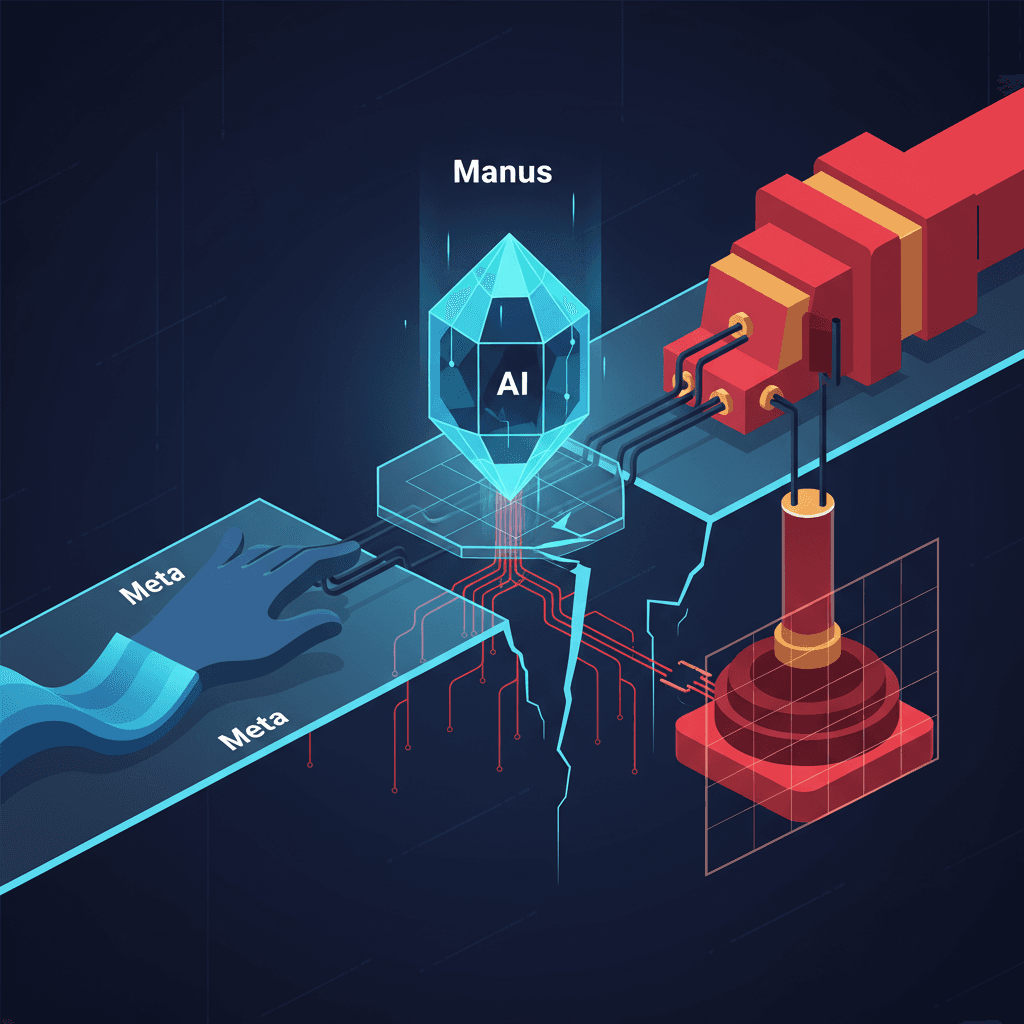
The proposed multi-billion dollar acquisition of the agentic artificial intelligence startup Manus by US technology giant Meta Platforms has ignited a high-stakes geopolitical contest, with reports indicating the deal may face rigorous scrutiny from regulators in Beijing. The acquisition, valued at an estimated $2.5 billion plus a $500 million employee retention pool, represents a major strategic move for Meta into the advanced AI agent space but has become entangled in the widening US-China technology divide. The central issue is Manus’s origin: while currently headquartered in Singapore, the company, whose parent entity was founded as Butterfly Effect in China, conducted its early-stage research and development work on the mainland, raising questions about whether key technologies were exported without proper Chinese authorization.[1][2][3][4]
Experts point to China’s stringent Regulations on the Administration of Technology Import and Export as the likely legal basis for potential intervention. The core concern for Beijing regulators will be to assess whether the transaction involves the unapproved transfer overseas of any technology that is prohibited or restricted under Chinese law. This scrutiny is complicated by the personal ties of Manus's founders and core team members; there has been no confirmation that they have relinquished Chinese nationality, which means they and the mainland-registered parent company could still be subject to Chinese jurisdiction. The perception in Beijing is that the deal effectively transfers technology developed by Chinese engineers to an American company, setting a precedent that may push other high-potential domestic AI startups to follow the same path, a dynamic viewed by some Chinese media outlets as a "defection."[1][3][5]
The circumstances surrounding Manus’s relocation to Singapore in mid-2025 illustrate the intense pressure of the current geopolitical climate on global AI development. The move followed a $75 million funding round in April 2025 led by the US venture capital firm Benchmark, an investment that immediately drew attention from US regulators concerned about American capital supporting Chinese-origin AI firms. The company, which had roots in Beijing and Wuhan, actively worked to disentangle its Chinese ties to secure access to US capital, computing resources, and international markets. This included rejecting investment offers from local Chinese governments, shelving a previously announced partnership with a Chinese tech firm to develop a local version of its tool, laying off a significant portion of its China-based workforce, and eventually discontinuing all services and operations on the mainland. This strategic move was, in effect, a pre-emptive measure to ease concerns in Washington, but it has now created a difficult situation with Chinese authorities who view the startup as a symbol of domestic AI strength being lost to a rival power.[1][6][3][7][8][5]
Manus’s technology, which centers on semi-autonomous AI agents capable of performing complex, multi-step tasks like market research and coding, is precisely the kind of cutting-edge innovation that both the US and China are fiercely competing to control. The startup's rapid growth, achieving a $125 million annual recurring revenue run rate in a short period, highlights the strategic value of its technology to Meta, which plans to integrate the agent platform across its major products including Meta AI, WhatsApp, and Instagram. Should Beijing decide to formally intervene, it could trigger a complex legal and political battle. While Meta has stated that all Chinese ownership interests will be terminated and all Chinese operations will cease upon the deal’s closing, the question of whether a prior, unapproved technology transfer occurred remains an open regulatory risk in China. The geopolitical ramifications of the transaction are already evident, demonstrating how companies, even those physically relocating and severing operational ties, struggle to fully decouple from their country of origin in the sensitive field of advanced technology.[1][6][2][9][10][11][12]
This situation carries profound implications for the global AI industry, particularly for Chinese-founded startups seeking international expansion and US investment. If Beijing successfully blocks or complicates the acquisition, it would likely deter future ventures from attempting a similar move, potentially strengthening China's domestic 'Great Firewall' around its most promising technological assets. Conversely, if the deal closes despite the protests, it could be interpreted in Washington as a successful outcome of US export controls and investment restrictions, which effectively pressured a leading Chinese AI company to "defect" to the West. However, either result intensifies the regulatory burden and geopolitical risk for all cross-border technology deals, compelling founders to choose a side in the escalating technological cold war and raising the barrier for global capital flow into the Asian AI ecosystem. The dispute over Manus marks a significant inflection point, showing that an AI company’s intangible assets—its early R&D, core team nationality, and technological genesis—can subject it to national security and export control regimes long after it has physically moved its headquarters.[1][13][14][5]
Sources
[1]
[4]
[7]
[9]
[10]
[12]
[13]
[14]