
Anthropic Warns AI Exponential Growth Collides With Economic Reality
Anthropic's economic reality check: High compute costs and slow enterprise adoption threaten the exponential curve.
January 4, 2026
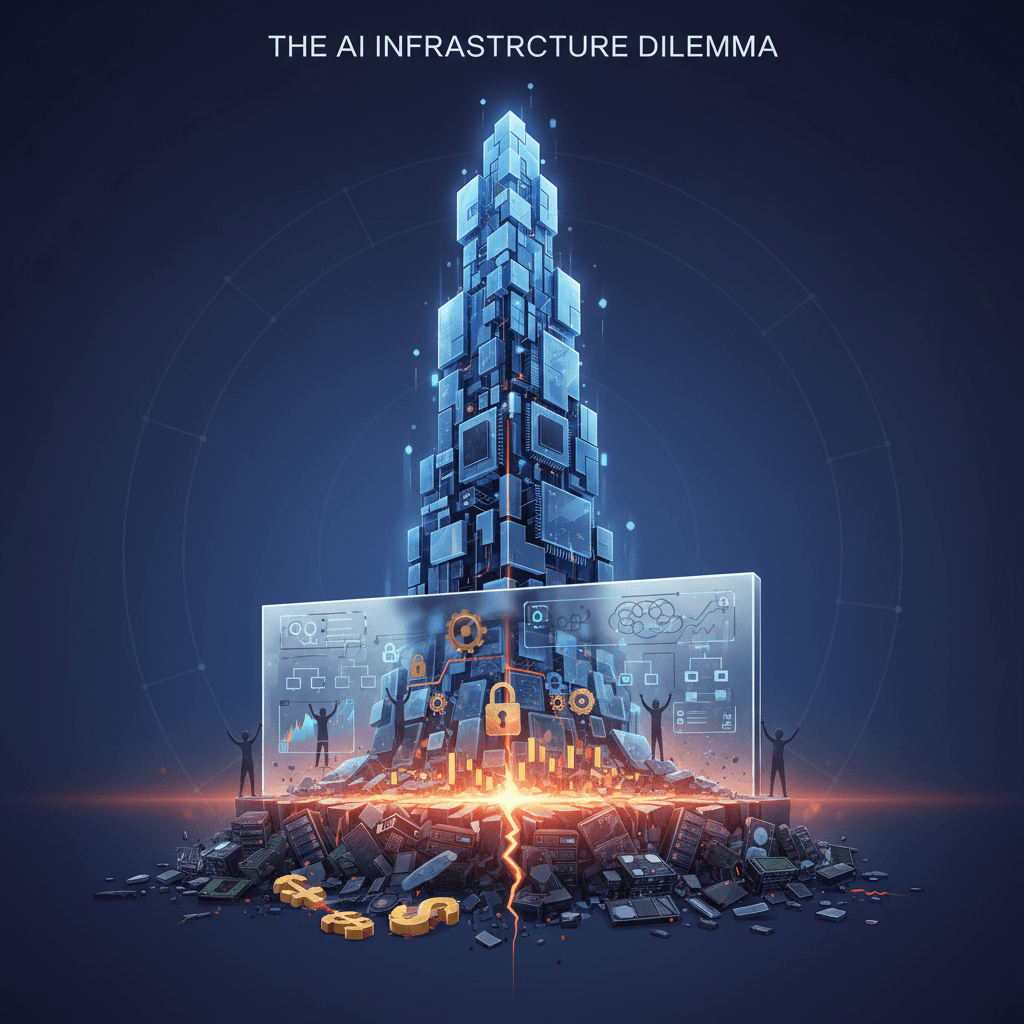
The relentless ascent of artificial intelligence capabilities, driven by ever-larger models and exponential compute power, has become the defining technological trend of the decade, yet Anthropic President Daniela Amodei has introduced a pivotal piece of cautionary realism to the industry’s otherwise boundless optimism. Her measured assessment, which suggests "the exponential continues until it doesn't," acknowledges the extraordinary technological surge while clearly separating it from the less predictable forces of economic reality and human integration. Amodei’s statement, shared internally and now widely discussed, is not a prediction of a technological plateau, but a warning that the economic and organizational infrastructure supporting the boom is far more fragile than the science that powers it. The real question, she posits, is not how good the technology can get, but "How quickly can businesses in particular, but also individuals, leverage the technology?"[1]
The technological narrative of AI has, until now, been dominated by scaling laws, a concept Anthropic's co-founder and CEO Dario Amodei helped to pioneer, which dictates that predictable performance gains follow increases in model size, data, and compute. This has fueled an "AI arms race" where top-tier firms are committing staggering sums to computing power. Training costs for frontier models, such as the one behind ChatGPT-4, have historically been in the range of $100 million, with estimates for next-generation models nearing the $1 billion mark, and future models potentially costing tens or even a hundred billion dollars.[2] This pace of innovation requires a staggering compute demand, which is currently growing at a rate two times faster than Moore's Law.[1] The commitment to this exponential curve is evident in the infrastructure spending: competitors like OpenAI have entered into agreements suggesting a multi-trillion dollar commitment to compute and infrastructure, a figure that dwarfs most corporate capital expenditure plans.[1][3] Daniela Amodei's caution reflects the internal surprise that even those who established the scaling paradigm have felt, noting that every year they wonder if the exponential growth will finally cease, and every year it has continued.[1]
However, the chasm between technological capability and economic viability has become the industry’s central tension, transforming the conversation from an engineering challenge into a financial one. Anthropic's leadership has been outspoken about the risk of an infrastructure "bubble" driven by speculative, high-risk capital expenditure. Dario Amodei has warned against "timing errors" and companies taking unwise risks, or "YOLO-ing," by investing heavily in massive, expensive data centers without a clear guarantee that future revenue will cover the enormous electric bills and capital outlay.[4][5] This risk is amplified by the volatility of AI-specific hardware, particularly the high-performance Graphics Processing Units (GPUs) that power these models. While some investors argue that older chips retain significant value, the rapid innovation cycle of manufacturers like Nvidia threatens to accelerate asset depreciation far beyond conventional accounting schedules, which typically span five to six years.[6][7][8] The economic useful life of an AI chip—the time before a newer, vastly more efficient model makes the old one competitively unprofitable—is a huge unknown, creating a "cone of uncertainty" for companies whose financial strategy is built on long-term hardware utility.[9] If the revenue growth from adoption slows, heavily leveraged infrastructure could quickly become a financial strain, injecting turbulence into the market.[10][11]
The most significant friction point to the sustained exponential growth is found not in the silicon, but in the human factor of enterprise adoption and integration. The initial hurdle of technical performance has been largely overcome, but the subsequent challenges of integrating AI into real-world business systems are proving more complex than invention itself. Enterprise adoption of AI often slows dramatically after initial proof-of-concept projects, running up against organizational friction points such as lengthy security reviews, compliance requirements, unclear accountability, and a lack of trust in the technology's accuracy.[12][13][14] Furthermore, academic research on AI adoption in sectors like manufacturing suggests a "productivity J-curve," where firms actually experience a measurable, albeit temporary, decline in performance following AI introduction due to the necessity of systemic change and adapting legacy operational processes.[15] This initial productivity hit, combined with the significant capital investment required, creates a financial hurdle for smaller firms, leading to uneven adoption across the economy.[16] This lack of institutional readiness and the subsequent lag in broad economic leverage is the precise "human factor" Daniela Amodei pinpoints as the potential breaking point for the market’s exponential economic curve.
In response to this cautious outlook, Anthropic has adopted a distinct "do more with less" strategy, positioning itself as a counter-narrative to the industry's brute-force scaling race.[3][9] This approach prioritizes algorithmic efficiency, high-quality training data, and post-training techniques to maximize model performance per dollar of compute, in contrast to rivals who rely on massive scaling alone.[17] The company's models, which have been competitive in terms of reasoning and performance despite a fraction of the capital and compute resources of its peers, demonstrate the viability of this disciplined resource allocation.[3][9] This strategy is fundamentally linked to the co-founders’ original ethical vision, which centers on building safe, reliable, and steerable AI.[18][19] By focusing on constitutional AI and making models easier and cheaper to run, Anthropic is addressing the friction points—trust, explainability, and cost of operation—that currently impede wide-scale enterprise adoption.[17][13] Daniela Amodei’s pragmatic warning thus serves as both a macroeconomic observation on the industry's bubble risk and an articulation of her company’s core business philosophy: that superior algorithmic intelligence and responsible, efficient deployment will ultimately prove more resilient than sheer computational scale in navigating the inevitable economic turbulence ahead.
Sources
[2]
[3]
[5]
[6]
[9]
[10]
[12]
[13]
[14]
[15]
[16]
[17]
[18]
[19]