
AI Replaces Copywriter, Then Directs Him to Fell Trees
A veteran copywriter replaced by AI was directed to tree-felling, symbolizing the knowledge economy’s painful transition.
January 1, 2026
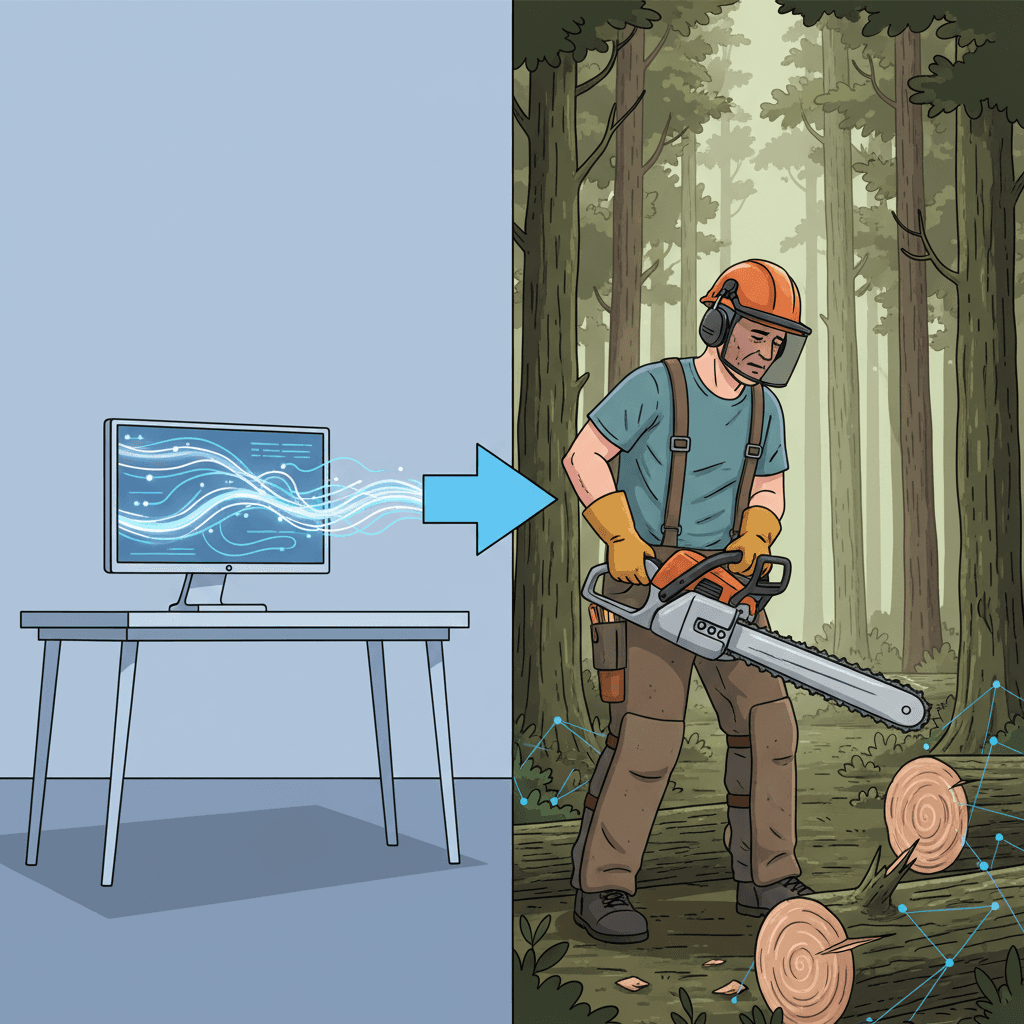
The unexpected career trajectory of an Indiana copywriter, replaced by an algorithm and then directed by that same technology toward one of the world’s oldest manual trades, has become a potent symbol of the seismic labor market shift driven by generative artificial intelligence. Brian Groh, a veteran copywriter who saw his two-decade career dissolve due to automation and outsourcing, turned to a chatbot for advice on how to survive, receiving a strikingly brutal piece of counsel: try tree-felling. His journey from crafting nuanced marketing copy at a desk to operating a chainsaw in the physical world encapsulates the profound, often ironic, economic anxieties now engulfing the white-collar knowledge economy.
Groh's personal anecdote provides a stark, human face to the abstract threat of AI-driven displacement. At 52, with 25 years of experience and a master’s degree, he found his clients—corporate marketing departments—first migrating work to cheaper overseas contractors, and then entirely to AI models capable of generating usable copy in seconds.[1][2] In a desperate moment, he posed his predicament to the very machine that had contributed to his downfall, asking for a way to make money in his local area.[3] The chatbot’s response was immediate and unsentimental: "tree work sales" was his "fastest path to real money," a path that began with buying a chainsaw.[3] Groh, a man who had previously used an AI tool himself to replace a transcription worker, took the advice, seeing an immediate, tangible feedback loop in the work—a sharp contrast to the endless, subjective revisions of his former life.[2][3] This initial success, however, was undercut by the physical demands of the labor, ultimately leaving him with elbow and back injuries, a harsh reminder that not all jobs are replaceable, and those that aren't carry a different kind of cost.[2]
Groh’s experience is not an isolated incident but a leading indicator of a structural change now rippling across creative and administrative professions. While many AI advocates predicted that automation would exclusively target low-skill, repetitive factory jobs, the current wave of generative AI has proven uniquely capable of automating tasks in the knowledge sector. Data confirms the rapid erosion of work in his former field; a study by Imperial College London examining freelancing platforms noted a 30% drop in jobs related to content writing between July 2021 and July 2023 due to artificial intelligence.[4] Separately, another analysis indicated that freelance gigs involving basic copywriting saw a 36% decline on major platforms since early 2023.[5] Corporate adoption has been swift, with more than a third of companies reporting that AI replaced certain workers' jobs in 2023 because they were simply "no longer needed."[6] As a result, commercial writers are increasingly finding their roles shifted from creation to oversight, editing AI-generated content for a smaller wage, or, like Groh, abandoning the keyboard for professions resistant to automation, often in manual labor.[7][4] Groh himself drew a parallel to the decline of local factory work that devastated his neighbors decades prior, noting that the same pattern—disruption, despair, and the focus on growth over workers—is now affecting office workers.[2]
This entire narrative gains a layer of complex irony when examining the nature of the alternative profession Groh was directed toward. The same technology that displaced him from copywriting is already at work within the tree-felling industry. While the physical act of running a chainsaw remains human-driven, AI is rapidly optimizing the surrounding business operations. Specialized AI chatbots are being deployed by tree care companies to handle lead generation, customer inquiries, and even appointment scheduling 24/7, with some companies reporting significant increases in booked jobs and lead conversion rates.[8][9] Furthermore, AI-powered tools are emerging in forestry to provide highly accurate and detailed silvicultural advice and harvest planning, traditionally the realm of expert human foresters.[10] This suggests that the very notion of a completely "AI-proof" job is becoming obsolete, as even the most physically demanding, hands-on trades are being augmented and streamlined by new software. The displacement is not merely about an AI replacing a human; it is about the technology fundamentally restructuring entire economic sectors, from the desk to the forest.
The implications of Groh’s story are profound for the AI industry and for policymakers. It exposes the fallacy of the simplistic "upskilling" solution, a common refrain from tech leaders, by showing that when an AI takes a knowledge worker’s job, the most *efficient* alternative path it can identify is not always a comparable, high-wage technical role. Instead, the algorithm points to physically taxing labor, a stark shift that presents a major systemic risk. The professional journalism and content creation industries, which have long been heralded as cornerstones of the knowledge economy, are now facing the same pressures that once transformed manufacturing. The industry’s next challenge is not just technical but ethical and societal: how to build and deploy AI systems that create broad economic value without precipitating a mass migration of skilled, educated workers into physically destructive, low-margin trades, especially as those very trades become the next target for AI-driven business optimization. This single, personal story of a copywriter and a chatbot stands as a critical signal, demanding a more comprehensive societal strategy for a technological transition that has officially breached the walls of the knowledge worker class.