
AI Hunger Forces Alphabet to Buy Energy Giant Intersect Power
The $4.75 billion clean energy deal signals a fierce, high-stakes arms race to power the AI infrastructure boom.
December 22, 2025
The parent company of Google, Alphabet, has executed a significant strategic maneuver to secure the immense energy requirements of its rapidly expanding artificial intelligence operations by acquiring clean energy developer Intersect Power for $4.75 billion in cash, plus the assumption of debt. This transaction is one of the largest direct energy investments made by a major technology firm and signals a fundamental shift in how tech giants are addressing the explosive, power-hungry growth of the AI era. The deal grants Alphabet access to a substantial pipeline of energy generation projects currently in development or under construction, providing a dedicated, long-term source of clean electricity to fuel its global data center infrastructure.[1][2][3]
The acquisition is a direct response to an unprecedented surge in energy demand driven by the development and deployment of generative AI. Large Language Models, the technology underpinning products like Google's Gemini, require staggering amounts of computation. For example, the initial training of a foundational model like GPT-3 consumed an estimated 1,287 megawatt hours (MWh) of electricity, which is roughly equivalent to the annual energy consumption of 130 US homes.[4][5][6] The energy draw does not end with training; a single query to a generative AI chatbot can consume approximately 0.3 kilowatt-hours (kWh) of electricity, a thousand times the power needed for a traditional Google search.[5] This voracious appetite for power has already contributed to a sharp increase in Google’s environmental footprint, with the company’s carbon emissions rising by 48% between 2019 and 2024, largely due to data center operations.[1] To maintain its aggressive AI roadmap, which involves doubling its capacity every six months and aiming for a thousandfold increase in output within four to five years, Google recognized that passively waiting on public utility grids was no longer a viable strategy.[7]
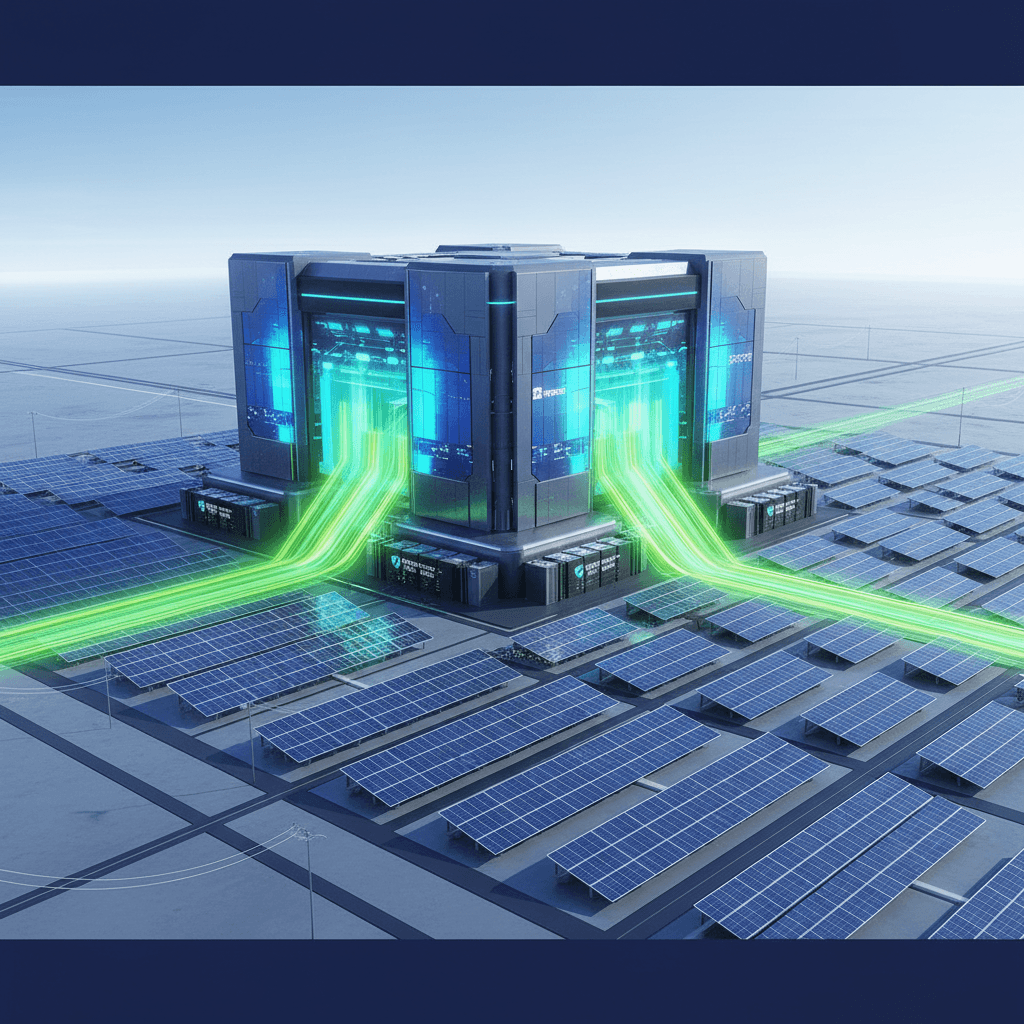
Intersect Power, a specialist in utility-scale solar and battery storage projects, offers a direct pathway to meeting this demand with its innovative "power-first" strategy. The firm's portfolio, with projects valued at around $15 billion, is slated to bring approximately 10.8 gigawatts (GW) of capacity online by late 2028.[8][7] The core of the strategy involves creating co-located "energy parks," where massive clean energy generation sites—combining solar and storage—are built alongside new data center campuses. This model accelerates the speed at which new data centers can become operational, as their power source is developed in lockstep with the facility itself, bypassing the often-interminable delays associated with connecting major new loads to the aging US power grid.[9][10] Intersect Power's CEO has publicly noted that AI expansion is "stuck behind" the electric power industry, advocating for a model where industrial consumers "bring your own generation."[8] Under the deal, Intersect will operate independently but work closely with Google's technical infrastructure team to rapidly deploy these projects, including a co-located site already under construction in Haskell County, Texas.[3][8][9]
This acquisition places Alphabet at the forefront of a costly and high-stakes arms race among hyperscalers to secure the world's limited energy supply for AI dominance. Its major competitors are pursuing similar, equally aggressive, and varied energy strategies. Microsoft, for instance, has committed to procuring power from a significant, yet controversial, source: the company is investing to restart the shuttered Three Mile Island nuclear power plant in Pennsylvania, which will supply dedicated power to its data centers.[11][12] Microsoft has also announced an agreement with a fusion energy startup for a new power plant expected to be completed by 2028.[13] Not to be outdone, Amazon is also making heavy investments in the nuclear sector, funding modular reactor development and acquiring a data center already connected to one of the nation’s largest nuclear facilities.[14][12] Meta, the parent company of Facebook, has also joined the fray, signing a 20-year deal to secure and expand output from a Constellation Energy nuclear plant in Illinois.[15] Even as Google doubles down on utility-scale solar and battery storage with the Intersect deal, it is simultaneously investing in next-generation nuclear technology, funding a company to design and build small modular reactors (SMRs) to deliver 500 megawatts of reliable, 24/7 power, with initial reactors anticipated to be online by 2030.[11][16]
The comprehensive vertical integration of energy infrastructure into the technology supply chain marks a watershed moment for the AI industry. The sheer volume of energy required—with projections that the AI sector could consume between 85 and 134 terawatt hours annually by 2027, rivaling the energy consumption of entire nations—means that access to power has become as critical a resource as advanced computing chips and top-tier talent.[5] By bringing Intersect Power in-house, Alphabet is not only advancing its corporate goal of achieving carbon-free energy operations but is more immediately transforming energy generation from a utility commodity into a proprietary competitive advantage. This move ensures a reliable, controlled, and scalable power supply, reducing development friction and providing a crucial competitive edge in the global race to build and commercialize the next generation of artificial intelligence. The success of this 'power-first' model will likely dictate the speed and scale of future AI infrastructure expansion, cementing the idea that for the AI boom to continue, the technology sector must first transform the global power grid.[17][8][10]