
AI Humanoids Exit Labs, Become Adaptable Workers in Major Industrial Shift
Cloud AI, dropping costs, and industrial pilots are accelerating the deployment of adaptable, learning humanoid robots.
January 9, 2026
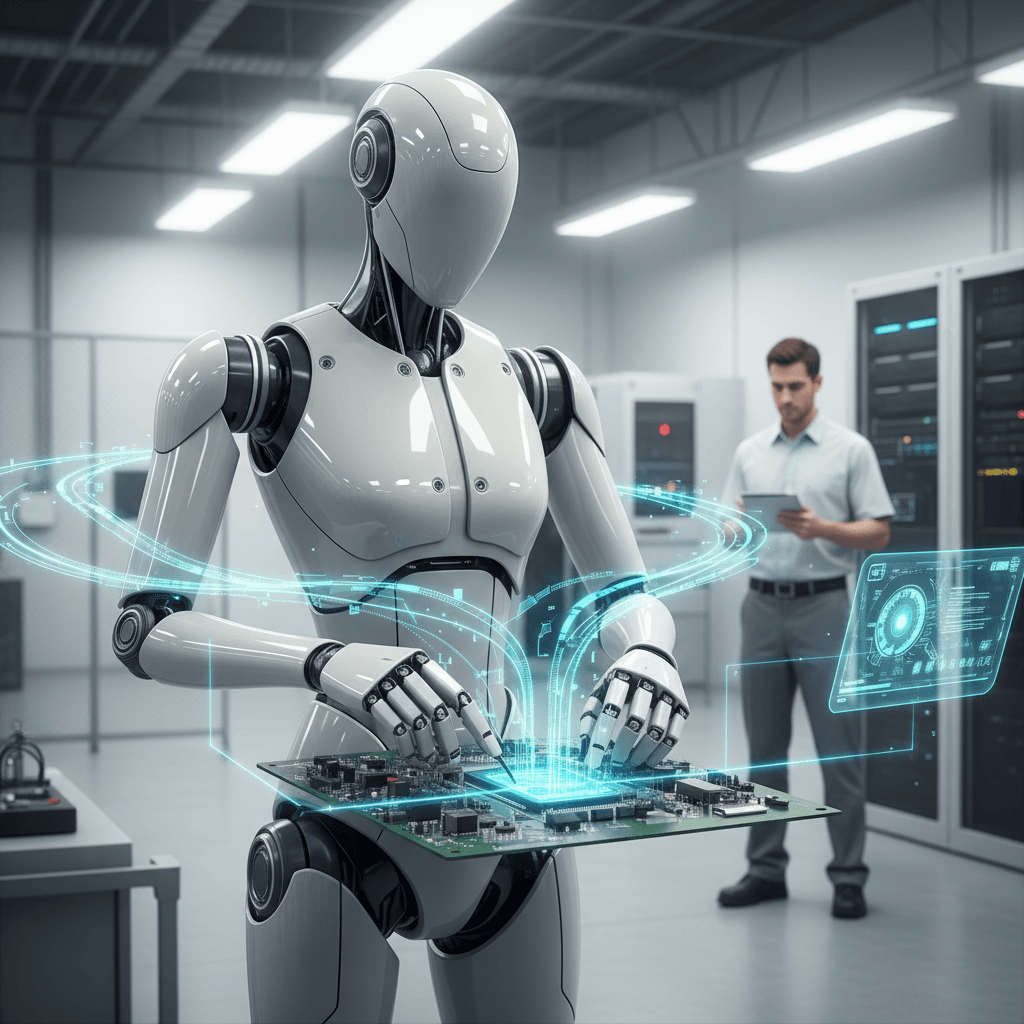
The boundary between science fiction and industrial reality is rapidly dissolving as a new generation of highly capable, artificially intelligent humanoid robots transitions from cloud-based prototypes to operational realities within the workplace. The convergence of advanced robotics, sophisticated sensor technology, and hyperscale cloud AI is marking an inflection point in automation, moving beyond fixed-arm industrial machinery to adaptable, mobile, and 'human-scale' workers. This shift is heralded by major strategic partnerships, such as the collaboration between Hexagon Robotics and Microsoft, which are specifically engineered to accelerate the deployment of humanoid systems into live industrial environments.[1][2][3]
The Microsoft-Hexagon partnership centers on data-driven, adaptive manufacturing, aiming to translate research in Physical AI into production-ready systems that can operate safely and efficiently alongside human workers.[1] Central to this effort is Hexagon’s industrial humanoid robot, AEON, which has demonstrated real-time defect detection and operational intelligence in controlled scenarios.[2][3] By integrating AEON's sensor fusion and spatial intelligence with Microsoft's cloud infrastructure, including Azure AI services and platforms like Fabric Real-Time Intelligence, the companies are addressing persistent barriers to deployment, such as managing data at scale and enabling 'one-shot' imitation learning for multimodal AI models.[2][3][4] This collaboration is a powerful signal that the next wave of industrial automation will be defined by intelligent, adaptable humanoid robots capable of learning from their environment and responding to real-world variability on the factory floor, initially targeting the automotive, aerospace, manufacturing, and logistics sectors.[1][2]
The acceleration of humanoid robots in the workplace is not confined to a single partnership. The entire industry is experiencing a rapid maturation that sees companies moving beyond flashy demonstrations to targeted commercial pilots. Leaders in the space, including Boston Dynamics, Figure AI, and Agility Robotics, are actively pursuing real-world deployments across warehouses and factories.[5][6] Boston Dynamics, for example, has unveiled the first production-ready version of its Atlas robot, which is being tested in an operational parts warehouse for Hyundai Motor Group.[7][8] Unlike traditional factory robots, the new generation of humanoids, with their bipedal mobility and dexterity, are designed to integrate seamlessly into existing, human-centric environments without the need for extensive retrofits or capital expenditure, offering a multipurpose solution for a wide range of activities.[9][7] Similarly, Figure AI’s humanoid is being piloted by BMW for intrafactory logistics, focusing on tasks that emphasize mobility and component movement between stations.[10] These industrial and commercial pilots are defining where humanoids can deliver immediate value, often substituting for wheeled robots or performing manual, repetitive tasks.[10]
This transformation is underpinned by significant advancements in the artificial intelligence that powers these machines. The robots are evolving into networked, learning systems rather than fixed, brittle automation.[8] The integration of advanced AI is rapidly enhancing their fine motor skills, enabling more precise, human-like movements and allowing them to adapt quickly to new tasks and dynamic environments.[11][9] Critically, the training process is becoming simpler and smarter, with the use of natural language AI enabling human instruction without specialized coding, making robot management feel more akin to people management.[9] Furthermore, through shared platforms, the skills learned by one robot can be instantly distributed to an entire fleet, turning the deployment of robots into compounding assets where capability increases over time.[8] The convergence of cloud AI and 'Physical AI' frameworks, including imitation learning, reinforcement learning, and multimodal vision-language-action models, is enabling robots to not only follow instructions but to understand and interpret their environment and even perceive their own skill deficits.[3][10]
The implications for the broader AI and industrial landscape are profound, touching on economics, workforce evolution, and safety. Economically, the unit cost of humanoid robots has been dropping significantly, in some cases by over 40% in just a few years, bringing them toward cost parity with human labor in certain physical roles.[9] This rapid decline in cost, coupled with labor shortages, aging populations, and reshoring efforts in developed countries, is creating a massive demand for automation to fill critical workforce gaps, particularly in manufacturing, logistics, and healthcare.[9][12] The industry's positioning is that humanoid robots are not designed for full workforce replacement but rather as a means of augmenting human workers, taking on physically demanding, repetitive, or hazardous tasks, thereby enhancing productivity and workplace safety.[1][11] This shift is expected to create new job categories, such as robot trainers, programmers, maintenance technicians, and human-robot interaction designers, as human workers are freed to focus on roles requiring creativity, emotional intelligence, and complex problem-solving.[12]
However, the transition is not without significant hurdles that the AI industry is actively working to overcome. The mass adoption of humanoids is contingent on addressing four key challenges: safety systems for fenceless operations to ensure regulatory compliance, sustained uptime to guarantee a return on investment, improved dexterity and mobility for a wider range of tasks, and greater learning efficiency to allow robots to generalize skills and adapt without needing billions of simulated interactions.[10] The ethical considerations of workforce displacement and the potential for AI-powered robots to perpetuate biases are also at the forefront of the responsible deployment discussion.[13] The path to becoming an essential tool of modern industry, rather than a novel concept, requires a continuous balance between innovation and ethical responsibility, with the focus on building confidence in humanoid robotics as a mainstream, scalable industrial tool.[1][6] The coming years will be critical in defining the balance and determining the role of these intelligent, human-scale machines in the future of work.
Sources
[3]
[5]
[7]
[8]
[9]
[10]
[11]
[13]