
Tech giants back $1 billion bipartisan initiative to retrain workers for AI displacement
Backed by major tech giants, the $1 billion bipartisan initiative aims to retrain workers but faces skepticism over corporate influence.
June 27, 2026
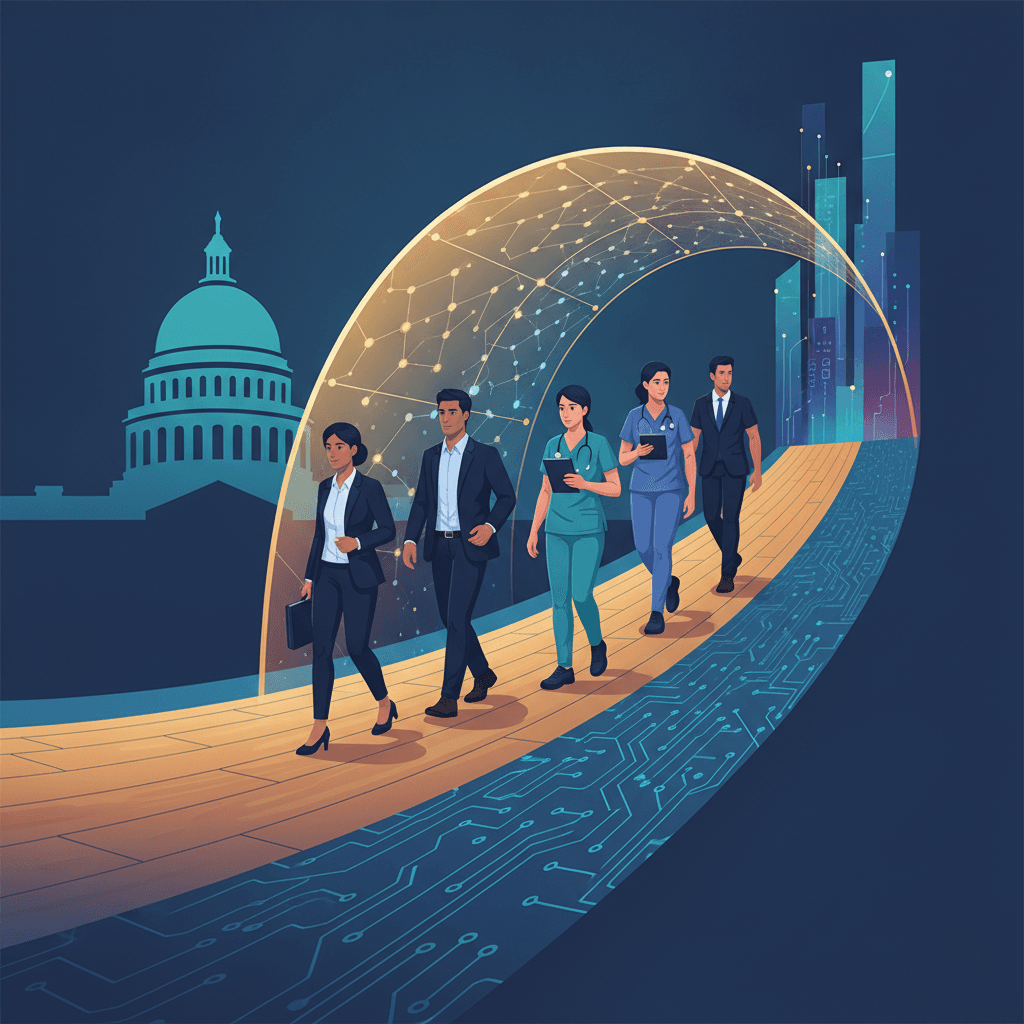
A new bipartisan national nonprofit has launched with the ambitious goal of preparing American workers for the massive labor market shifts driven by artificial intelligence. Known as RAISE US, the organization aims to secure $1 billion in multi-year commitments to design and scale training pathways, apprenticeships, and job transition programs across the country[1][2]. In an unprecedented move, the very technology giants driving the development of generative AI—Amazon, Anthropic, Microsoft, and the OpenAI Foundation—have signed on as the initiative's core anchor partners[3][1]. This direct financial backing from the corporate architects of automation has immediately ignited a debate over whether the program represents a genuine safety net for the future workforce or a highly calculated public relations campaign designed to ease the political and social fallout of widespread technological displacement[3][4].
The organization is led by a prominent bipartisan team featuring former United States Commerce Secretary and Rhode Island Governor Gina Raimondo, who serves as chief executive officer, and former Indiana Governor Eric Holcomb, serving as co-chair[5][6]. The duo has positioned the initiative as a necessary correction to what they describe as a critical gap in national planning[7][5]. While the federal government has heavily focused on keeping America at the forefront of the global technological arms race, leaders of the nonprofit argue that there has been no corresponding strategy to protect the human capital at risk of being left behind[8][5]. By bringing together leaders from opposing political parties, the organizers hope to transcend Washington gridlock and build a resilient framework that addresses structural employment challenges[9][10]. So far, the group has successfully secured over $500 million toward its ultimate funding target, leveraging a combination of corporate, philanthropic, and private investment[1][2].
To prove the viability of its models, the nonprofit is initiating pilot projects in four states: Arkansas, Connecticut, Maryland, and Utah[1][6]. These proving grounds represent a deliberate balance of Democratic and Republican leadership, aiming to demonstrate that workforce adaptation is not a partisan issue[8][11]. In Arkansas, the organization is collaborating with the state government to deploy an AI-powered career navigation platform called Arkansas LAUNCH, which is designed to connect job seekers and students with personalized, employer-linked training programs[8]. Meanwhile, in Maryland, the partnership focuses on expanding service-year opportunities for high school graduates to enter essential fields such as healthcare and education[8]. By focusing on local ecosystems, the nonprofit aims to move faster and bypass the bureaucratic delays typical of federal workforce initiatives, testing safety-net concepts like wage insurance and rapid retraining programs directly on the ground[11][12].
Beyond its primary technology partners, the nonprofit has assembled a massive coalition of over two dozen major employers and philanthropic organizations to fund and implement these programs[1][5]. Bank of America has stepped forward as the primary corporate sponsor of an advanced manufacturing apprenticeship initiative, while other heavyweights like Eli Lilly, General Motors, IBM, Mastercard, Cisco, AMD, and Deloitte have also committed capital and resources[13][1]. Philanthropic funding comes from major institutions including the Rockefeller Foundation and Pivotal, the organization founded by Melinda French Gates[2][6]. Rather than merely tracking how many individuals enroll in training courses, the organizers have stated that the primary metric for success will be whether participants actually secure and maintain stable, high-quality employment[1][5]. This focus on long-term career outcomes is intended to address failures in traditional vocational school models that often struggle to align with the real-time hiring needs of modern industry[14].
The involvement of the world’s leading AI developers as primary funders of the retraining effort introduces a complex set of ethical and operational questions[3]. Companies like Microsoft, OpenAI, Amazon, and Anthropic are actively building systems designed to automate white-collar and blue-collar tasks alike, prompting critics to ask whether these firms should be trusted to shape the programs that retrain the workers they displace[3][14]. To protect the organization's policy development from corporate self-interest, the organizers have established a philanthropically funded Policy Lab[1][10]. This division of the nonprofit is explicitly insulated from corporate donations and is tasked with designing, testing, and incubating objective labor policies that can eventually be handed off to state and federal governments[1][10]. This firewall is intended to ensure that the nonprofit's research and policy recommendations remain independent and are not skewed to favor the commercial interests of its tech donors[1][10].
Despite these structural safeguards, many labor economists and industry analysts remain skeptical about the true efficacy of the program[4]. Some experts view the initiative as an industry-wide effort to preempt aggressive government regulation, allowing tech companies to demonstrate self-governance and head off public anger over layoffs[4][14]. The scale of the threat is immense; global economic projections suggest that more than half of the American workforce may require significant reskilling over the next several years to adapt to automated workflows[12]. Critics point out that training programs historically have a mixed track record of success, and many displaced workers struggle to find jobs that match their previous wages[11][14]. From this perspective, a $1 billion initiative, while substantial, represents only a fraction of the funding needed to counteract the systemic economic disruption that advanced generative AI models could unleash on the global workforce[14][12].
As the rapid adoption of artificial intelligence continues to reshape corporate balance sheets and job descriptions, the launch of this program underscores a growing acknowledgment that the human cost of innovation cannot be ignored[2][5]. The initiative represents a high-stakes experiment in corporate social responsibility, state-level experimentation, and bipartisan policy coordination[11][5]. Whether the organization can successfully build a scalable national platform for career transition, or whether it will ultimately serve as a temporary cushion for inevitable automation, will depend heavily on its ability to turn corporate-funded pilots into permanent public policy[8][5]. In the unfolding AI era, the race to build the technology of tomorrow is now irrevocably joined by the equally urgent race to ensure that the workers of today are not left behind[5].