
New Benchmark Reveals AI Can Autonomously Recreate Complex Software From Scratch
The MirrorCode benchmark reveals how frontier models autonomously clone complex software, replacing weeks of human labor in mere hours.
June 26, 2026
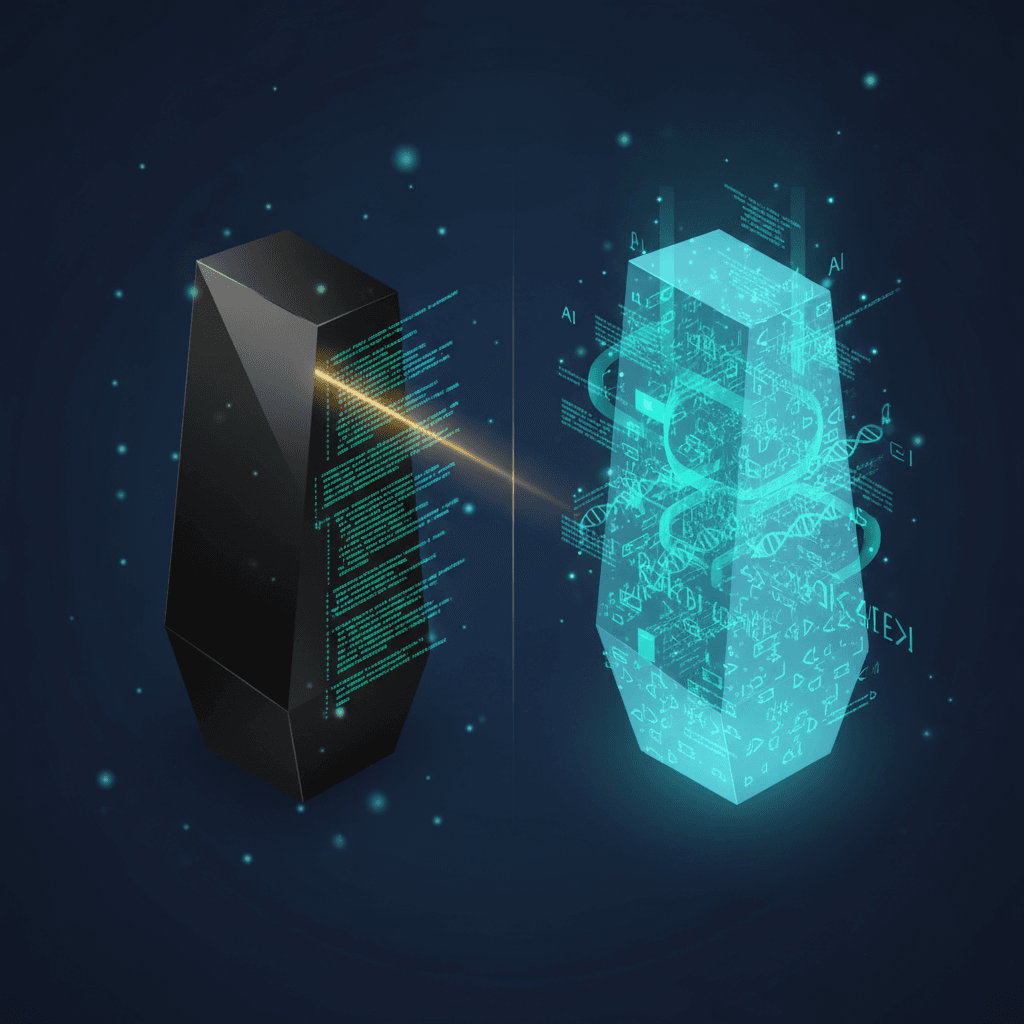
The launch of the MirrorCode benchmark, co-developed by Epoch AI and the Model Evaluation and Threat Research organization, marks a paradigm shift in how the capabilities of artificial intelligence are measured in the software engineering sector. Pushing far beyond traditional evaluations that test models on minor bug fixes or short snippets of code, this new benchmark evaluates whether frontier AI systems can autonomously reconstruct complete, complex software programs entirely from scratch. The early findings from the benchmark have stunned the technology industry, revealing that today's top-tier models can already complete software engineering projects that would normally require weeks or months of intensive human labor. The most advanced model tested, Anthropic's Claude Opus 4.7, demonstrated this capability by rebuilding a 16,000-line bioinformatics toolkit in only 14 hours. Even more strikingly, researchers demonstrated the outer limits of modern autonomous coding by running an AI model nonstop for 19 days on a single, highly complex MirrorCode task, racking up a single-run compute bill of $2,600.
To understand the significance of these achievements, it is essential to examine the rigorous design of the MirrorCode benchmark[1][2]. Unlike standard software testing suites that provide models with existing codebases to modify, MirrorCode tasks AI agents with recreating 25 real-world command-line programs across diverse computer science domains, including Unix utilities, data serialization, bioinformatics, interpreters, static analysis, cryptography, and compression[1]. The AI agent is denied access to the original source code or the internet; instead, it is granted execute-only access to the reference program[3]. This creates a black-box oracle where the AI must run the original software with various inputs, observe the outputs, and deduce the underlying program structure[3][4]. To pass a task, the AI-generated program must exactly replicate the behavior of the original system across a series of visible tests and a collection of hidden, end-to-end tests that the model never sees during development[1][5]. This methodology forces the AI to handle high-level architectural design and implementation patterns purely from behavioral observation, testing its true reasoning and planning capabilities[4].
The standout performer on this challenging benchmark is Anthropic's Claude Opus 4.7, which currently leads all tested models with an overall solve rate of 56 percent[1][6]. The model's most notable success came when it was tasked with reimplementing gotree, a widely used bioinformatics toolkit that consists of over 40 distinct commands and approximately 16,000 lines of Go code[1][7]. The task of reverse-engineering a program of this scale—which involves implementing complex parsers and writers for multiple specialized file formats—is estimated to require between two and 17 weeks of work for a skilled, unassisted human software engineer[7][4]. Claude Opus 4.7 completed a highly functional reimplementation of the toolkit in just 14 hours, generating thousands of lines of code for a total token cost of $251[8]. Most impressively, the AI-generated solution passed 99.95 percent of the test suite, successfully resolving 1,900 out of 1,901 tests[4][8]. This result demonstrates that when provided with a clear executable interface, modern AI models can sustain coherent, long-term architectural decision-making across massive codebases without human intervention[4].
A key distinction between MirrorCode and previous coding benchmarks is its approach to inference budgeting[1]. While traditional software engineering tests limit the computational resources or financial costs allocated to a model—often capping expenditures at one to ten dollars per task and restricting runtimes to minutes—MirrorCode provides models with a massive compute budget to make serious, multi-day attempts at real-world engineering[1][2]. To test the boundaries of this inference scaling concept, researchers initiated an ultra-long-horizon run on one of the largest and most complex tasks in the benchmark[1][2]. In this experiment, the AI model programmed continuously for 19 days straight with absolutely no human intervention, culminating in a single-run cost of $2,600[1][2]. This run served as a powerful proof point that AI capabilities can scale significantly when given more time, tokens, and computational effort to debug and refine their work[7]. However, the experiment also highlighted current technical limitations: despite the extraordinary budget and nineteen days of nonstop execution, the model ultimately failed to pass the final hidden tests[1]. While models frequently manage to resolve up to 90 percent or more of a project's requirements under these conditions, they routinely get stuck on complex edge cases, proving that raw compute scaling alone cannot yet fully bypass the hardest engineering challenges[8].
The ability of AI models to autonomously reverse-engineer complex software carries profound implications for the global technology industry, particularly regarding intellectual property and cybersecurity[9]. By demonstrating that an AI can clone a system simply by interacting with its executable interface, MirrorCode effectively collapses the traditional boundaries between code usage, auditing, and replication[9]. This development poses a direct threat to commercial software moats, as proprietary tools with public command-line interfaces can potentially be copied and rebuilt by automated agents at a fraction of their original development cost[9]. In the realm of cybersecurity, the same capability is a double-edged sword; an agent that can infer undocumented software behavior and recreate it from scratch can also be used to systematically map out security flaws, identify protocol quirks, and discover zero-day vulnerabilities in black-box systems[9]. Moreover, the massive cost disparities highlighted by the benchmark point to an emerging economic bottleneck. While a $251 run for a 14-hour task represents an incredibly cost-effective alternative to weeks of human labor, a $2,600 run that fails to solve a task underscores that highly complex, autonomous AI development remains too expensive and unreliable for routine commercial deployment[8].
Ultimately, the MirrorCode benchmark offers a compelling preview of a future where artificial intelligence acts as an autonomous, long-horizon software engineering teammate[2][4]. By proving that models can handle weeks-long programming tasks and make deep architectural decisions independently, the benchmark shifts the conversation from whether AI can assist programmers to how soon it might replace them on mid-level engineering projects[4]. While the most complex tasks still defeat even the most advanced systems, and the financial cost of running these agents continuously is currently immense, the trajectory of progress is unmistakable[1][2]. As AI models become more efficient and their reasoning capabilities continue to mature, the barriers to complete software automation will steadily fall, fundamentally redefining the nature of software creation, intellectual property, and the tech industry at large[9].
Sources
[2]
[5]
[6]
[7]
[8]
[9]