
ByteDance’s New iLLaDA Model Shatters the Autoregressive Monopoly on Large Language Models
By matching Qwen2.5, ByteDance’s new iLLaDA model proves that bidirectional diffusion can challenge the dominant autoregressive AI paradigm.
June 27, 2026
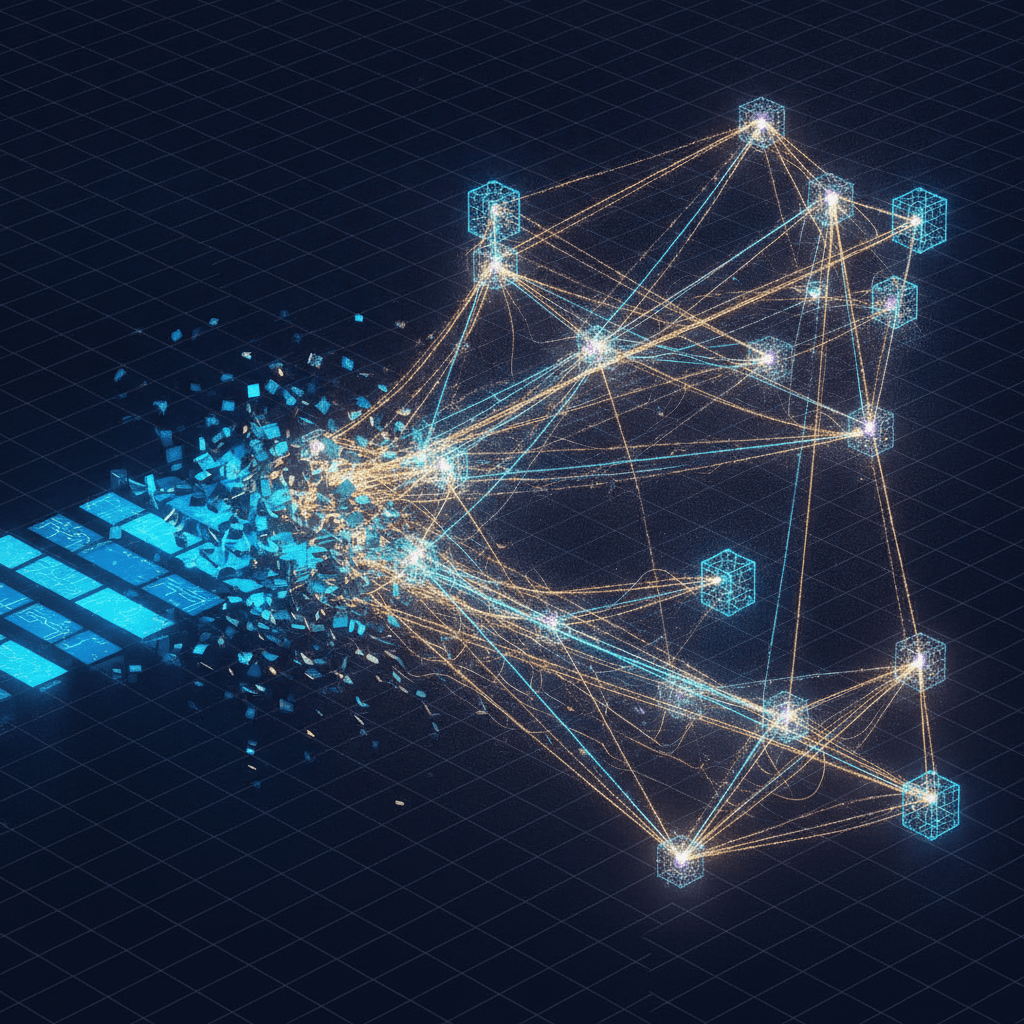
For years, the artificial intelligence industry has operated under the assumption that autoregressive training is the only viable method for building state-of-the-art large language models[1]. This left-to-right, one-token-at-a-time sequence prediction underpins almost every major conversational agent, from OpenAI's ChatGPT to Meta's LLaMA[2][3]. However, a major technological breakthrough from researchers at Renmin University of China and ByteDance's Seed team has fundamentally challenged this monopoly[2][1]. The research team has released iLLaDA, an eight-billion-parameter masked diffusion language model trained completely from scratch[2]. Utilizing a fully bidirectional attention mechanism rather than the traditional causal approach, iLLaDA generates text by reconstructing masked tokens across an entire sequence simultaneously[2][1]. The newly unveiled model matches the highly regarded Qwen2.5 base model across multiple industry benchmarks, proving that discrete-state diffusion models form a legitimate and highly competitive alternative to the dominant autoregressive paradigm[2][1].
The transition from autoregressive generation to a diffusion-based framework represents a radical shift in how machine learning systems process and synthesize human language[1][3]. Standard autoregressive models depend on causal masking, meaning they can only look backward to predict the next token in a sequence[2][3]. While this method has scaled exceptionally well, it introduces fundamental architectural limitations, most notably the reversal curse, where a model struggles to understand bidirectional relationships without explicit symmetric training[1][3]. In contrast, iLLaDA operates as a masked diffusion model, randomly masking portions of a sequence and learning to reconstruct those missing pieces in parallel[1][4]. Because it utilizes fully bidirectional attention, the model evaluates the entire context of a prompt simultaneously[2][1]. This allows for far more robust contextual understanding, enhanced bidirectional reasoning, and the potential for multi-token parallel decoding that could drastically accelerate inference speeds[1][5].
Achieving this level of competitiveness required an unprecedented scale of training for a non-autoregressive language model[1]. The researchers scaled iLLaDA's pre-training regimen to a massive twelve trillion tokens under a masked diffusion objective[2][1]. For its instruction-following variant, they utilized a twenty-five-billion-token instruction corpus, running supervised fine-tuning for twelve epochs[2][1]. To make such a large-scale diffusion model computationally feasible, the team integrated several sophisticated architectural innovations[1]. They employed grouped-query attention to dramatically reduce the model's memory footprint during processing, and utilized tied input and output embeddings to keep the total parameter count tightly constrained[1]. Furthermore, the researchers introduced variable-length generation to optimize inference efficiency, alongside a novel confidence-based scoring mechanism designed to enhance the accuracy of multiple-choice evaluations[2][6].
These engineering modifications have yielded spectacular performance gains compared to the model's predecessor, LLaDA[2][1]. The base version of iLLaDA demonstrated a massive developmental leap, improving by twenty-one point six points on the Big-Bench Hard benchmark and fourteen point nine points on the ARC-Challenge[2][1]. The instruction-tuned version, iLLaDA-Instruct, showed equally impressive strides, registering a fourteen point five point gain on the MATH benchmark and a sixteen point five point improvement on HumanEval, which tests python coding proficiency[2][1]. These leaps demonstrate that the refined training pipeline and architectural adjustments have successfully unlocked the capabilities of discrete diffusion, propelling the model into direct competition with established industry benchmarks[2][1].
The core headline of the research lies in how iLLaDA-Base fares against Alibaba's state-of-the-art Qwen2.5 seven-billion-parameter model[1]. In head-to-head base model evaluations, iLLaDA-Base was described as slightly stronger on average than its autoregressive counterpart[1]. It achieved the top results among all compared models on several critical benchmarks, including the Massive Multitask Language Understanding suite, Big-Bench Hard, the ARC-Challenge, and GSM8K, which measures grade-school math solving capabilities[1]. This achievement is particularly notable because Qwen2.5 is widely considered one of the most powerful open-weight base models currently available[1][7]. Matching and occasionally exceeding its performance without relying on the traditional causal attention structure proves that bidirectional diffusion can model the complex distributions of natural language with equivalent depth[1].
Despite the success of the base model, the comparison becomes more nuanced when examining the instruction-tuned iterations[1]. The iLLaDA-Instruct model still trails Qwen2.5-Instruct, particularly on highly complex mathematical reasoning and coding tasks[1]. The researchers attribute this divergence to a disparity in the post-training alignment phase[1]. While Qwen2.5 has benefited from extensive reinforcement learning with human feedback and advanced direct preference optimization techniques, iLLaDA-Instruct has only undergone supervised fine-tuning[1]. Reinforcement learning is crucial for formatting outputs, eliminating unnecessary noise, and keeping reasoning models on track during multi-step logic paths[1]. Because the diffusion framework has not yet been integrated with these complex reinforcement learning loops, it remains at a temporary disadvantage in specialized instruct tasks[1].
The paper also flags unique behavioral quirks that emerged during the instruction-tuning phase of iLLaDA[1][8]. On particularly difficult reasoning problems, the instruction-tuned model occasionally gets stuck in repetitive reasoning loops[1][8]. For example, when confronted with a complex multi-step question, the model might repeatedly output variations of phrases like "Wait, let me check again" without ever advancing to produce a final, concrete answer[8]. The researchers traced this behavior back to specific subsets of the supervised fine-tuning corpus, which contains structured chain-of-thought traces generated by reasoning-centric models[8]. To mitigate this issue, the team introduced a dynamic control mechanism: as the generated text grows longer, the model gradually increases the probability of emitting a stop-thinking token, prompting the system to break the loop and deliver a final response[8].
The current iteration of iLLaDA is capped at the eight-billion-parameter scale, leaving open the vital question of how these results will hold as the model scales to tens or hundreds of billions of parameters[1]. Nonetheless, the implications of this research for the broader artificial intelligence industry are profound[1]. By demonstrating that a fully bidirectional diffusion model can go toe-to-toe with premier autoregressive models, ByteDance and Renmin University have opened a new frontier in AI architecture[2][1]. If future developments can successfully implement reinforcement learning on top of diffusion models and resolve the remaining instruction-following gaps, the industry may see a shift toward parallel-decoding architectures[1][9]. This would not only overcome the sequential bottlenecks of modern conversational AI but also pave the way for faster, more logically robust, and truly bidirectional reasoning engines[3][9].
Sources
[1]
[2]
[3]
[4]
[6]
[7]
[8]