
AI transitions from passive chatbots to autonomous digital colleagues that complete entire tasks
Integrating deliberate reasoning with persistent workspaces is transforming conversational chatbots into autonomous and reliable digital colleagues.
June 28, 2026
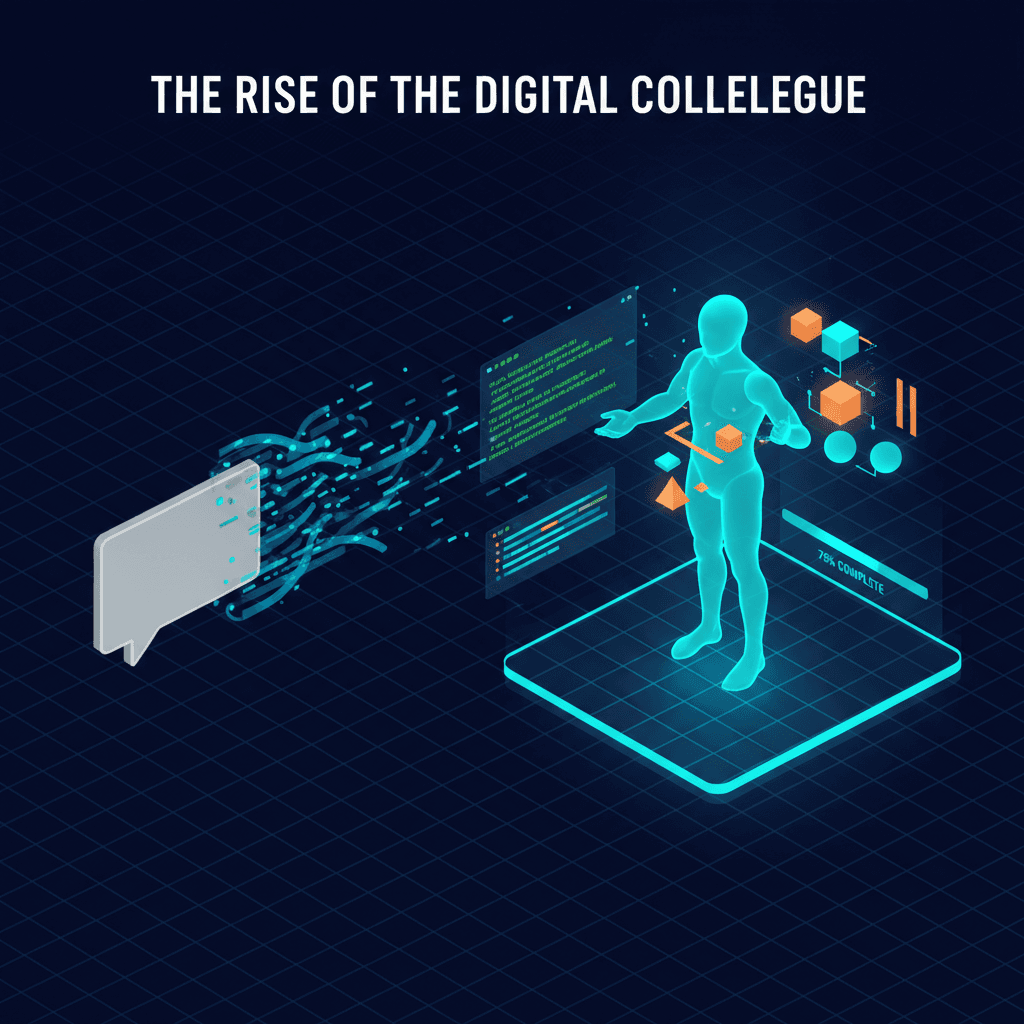
The artificial intelligence industry is on the cusp of a fundamental transformation, transitioning from an era of passive, session-based chatbots to one of persistent, autonomous digital colleagues. For years, users have interacted with large language models through ephemeral conversational loops, treating them as sophisticated search engines or text generators. However, a landmark survey paper co-authored by researchers at Tencent Youtu Lab and several prominent academic institutions—including Tsinghua University, Sun Yat-sen University, Central South University, and the University of Illinois at Chicago—argues that AI systems will never become reliable coworkers until they stop merely answering questions and start finishing entire tasks[1][2]. Titled From Chatbot to Digital Colleague: The Paradigm Shift Toward Persistent Autonomous AI, the research outlines a crucial evolution[3]. Instead of striving to generate the most linguistically pleasing response, the artificial intelligence sector must focus on building execution frameworks where AI can reliably turn human intent into completed digital work within persistent environments[4][5].
The foundational transition from simple chatbot interactions to true collaborative intelligence begins with a dramatic shift in how models process information. In the traditional chatbot era, large language models operated primarily on fast, intuitive processing, which psychologists often refer to as System 1 thinking[6]. These models generated text token by token, relying entirely on their static parametric knowledge to write an answer in a single, uncorrected pass[7]. The emerging era of thinking language models, catalyzed by architectures such as OpenAI's o1 and DeepSeek-R1, introduces deliberate System 2 reasoning[6][7]. By allocating extra computational power at inference time, these newer systems engage in slow, deliberate thinking[6]. They map out complex reasoning paths, generate long chains of thought, verify intermediate calculations, and correct their own mistakes mid-process[1][6]. Rather than being trained solely to produce a high-probability final answer, these cognitive engines learn via reinforcement learning with process-level supervision, earning rewards for sound, verifiable logical trajectories[6]. This internalization of self-correction represents a major leap toward cognitive reliability, providing the reasoning core necessary for real-world delegation[1][6].
Beyond purely cognitive improvements, transforming AI into a reliable teammate requires moving away from fleeting tool calls toward stable, persistent execution environments. First-generation autonomous agents showed promise by calling external APIs, browsing the web, and writing code, but they ultimately proved highly fragile in production[8]. Researchers identify several structural bottlenecks in these early systems, noting that they perceived their digital environments only in disconnected fragments, left no lasting system state between tool invocations, and easily broke when encountering unexpected errors[1][8]. The solution to these limitations lies in the transition to persistent workspaces, characterized as the OpenClaw era of workstation systems[3][8]. In this paradigm, the agent operates inside a persistent workstation where files, terminal sessions, execution logs, web browsers, and authorization permissions survive across the entire multi-step workflow[9]. By integrating agents into controlled, enduring development environments, systems like SWE-agent and OpenHands ensure that the AI can work continuously, observe the long-term consequences of its actions, and debug its own failures until a task is completely resolved[9].
The true architectural breakthrough for a digital colleague lies in the dual integration of persistent workspaces and reusable skills[3]. While a workspace provides the state, storage, and actual consequences of an action, a skill packages operational knowledge into reusable, versioned bundles[10][11]. Traditional agent setups relied on chaotic, ad-hoc prompting where developers had to reinvent task execution rules for every single interaction[12][11]. In contrast, the workspace-plus-skill paradigm organizes recurring workflows into highly structured, portable skill packages[11]. This design is already being formalized by organizations like Anthropic, whose Agent Skills system bundles instructions, automation scripts, and underlying resources into designated directories containing standardized documentation[13]. By positioning reusable skills between the model's abstract reasoning core and the concrete workspace execution layer, organizations can systematically capture, test, and preserve proprietary operational know-how[14]. This collaborative layout allows AI assistants to steadily build a library of capabilities, though it also introduces a new set of software engineering demands, such as skill lifecycle management, regular workspace hygiene to clean up stale or broken artifacts, and guardrails to prevent skills from overfitting to narrow, non-transferable scenarios[15].
Shifting the functional target of artificial intelligence from conversational answers to finished tasks forces a complete overhaul of training datasets, evaluation benchmarks, and operational security protocols[14]. Traditional machine learning models were trained on static instruction-response pairs and evaluated on semantic correctness[16][14]. Conversely, workspace-centric systems must learn from state-action-observation trajectories, which capture the complete history of a workspace's state, the specific commands executed by the agent, and the corresponding terminal observations[17][14]. Evaluation is also moving away from grading the plausibility of an answer and toward task closure, measuring whether the agent successfully drives the target environment to a verifiable final state[1][14]. Modern benchmarks like SWE-bench, OSWorld, and WebArena reflect this demanding new reality by requiring fully reproducible starting states and rigorous end-state checking[14]. The difficulty of this shift is highlighted by the fact that older frontier models like GPT-4 initially solved only 14 percent of tasks on WebArena, illustrating the massive gap between static knowledge and dynamic task completion[14]. Furthermore, because these persistent workspaces expand the overall attack surface by holding sensitive API credentials, local databases, and communication channels, security frameworks like OpenClaw PRISM and ClawGuard are emerging to enforce runtime safeguards, tracking data provenance, managing strict permissions, and auditing the system's actions[18]. Data sovereignty also becomes a critical operational challenge, as workspace agents continuously observe sensitive source code repositories and proprietary internal documents that could accidentally be absorbed into future training loops[18].
Ultimately, the transition from conversational chatbots to autonomous digital colleagues represents a profound shift in how the technology industry conceptualizes artificial intelligence[3]. Achieving true autonomy is not merely a matter of scaling up the raw parameter count of foundational models, but rather a multi-disciplinary engineering challenge that demands robust execution substrates, reusable skill repositories, and strict governance frameworks[1]. As systems evolve to learn from their own operational traces, they will increasingly operate within secure, sandboxed environments that can handle the long-horizon complexity of actual professional roles[1][19]. By combining deep, deliberate reasoning with persistent work environments, the AI systems of the future will move past the limitations of simple text generation[4][5]. When artificial intelligence can safely edit files, test its own code, manage its dependencies, and verifiably close out tasks without constant human intervention, it will finally transcend its role as a conversational tool and become a true, reliable coworker in the modern enterprise[9][20].
Sources
[1]
[2]
[4]
[6]
[10]
[11]
[12]
[13]
[14]
[15]
[16]
[17]
[18]
[19]
[20]